By Martin Lowe, Managing Director, SAFE Fire & Security Systems Ltd, Halesowen Last updated: 25 October 2026
The short answer: A commercial fire alarm system detects a fire early and warns everyone in the building so they can get out. It’s made up of a control panel, detectors, manual call points and sounders, and in the UK it should be designed, installed and maintained to BS 5839-1. The main choices are conventional, addressable or wireless, and the right one depends on the size of your building, how it’s used and what your fire risk assessment says.
If you’re choosing a fire alarm system for your business, this guide is for you. It’s written for business owners, facilities managers, school business managers and anyone responsible for a commercial or public building. It explains what goes into a commercial fire alarm, the different types, the categories in BS 5839-1, and how monitoring and servicing work.
What does a commercial fire alarm system do?
It has two jobs: to detect a fire as early as possible and to warn people so they can leave safely. Some systems also do a third job: they signal an alarm receiving centre, release held-open fire doors, shut down ventilation or recall lifts.
Under the Regulatory Reform (Fire Safety) Order 2005, almost every non-domestic building in England and Wales needs a suitable way to detect fire and raise the alarm. The responsible person has to make sure it’s in place and kept working. Our guide to the responsible person and their legal duties explains who that is.
What’s in a fire alarm system?
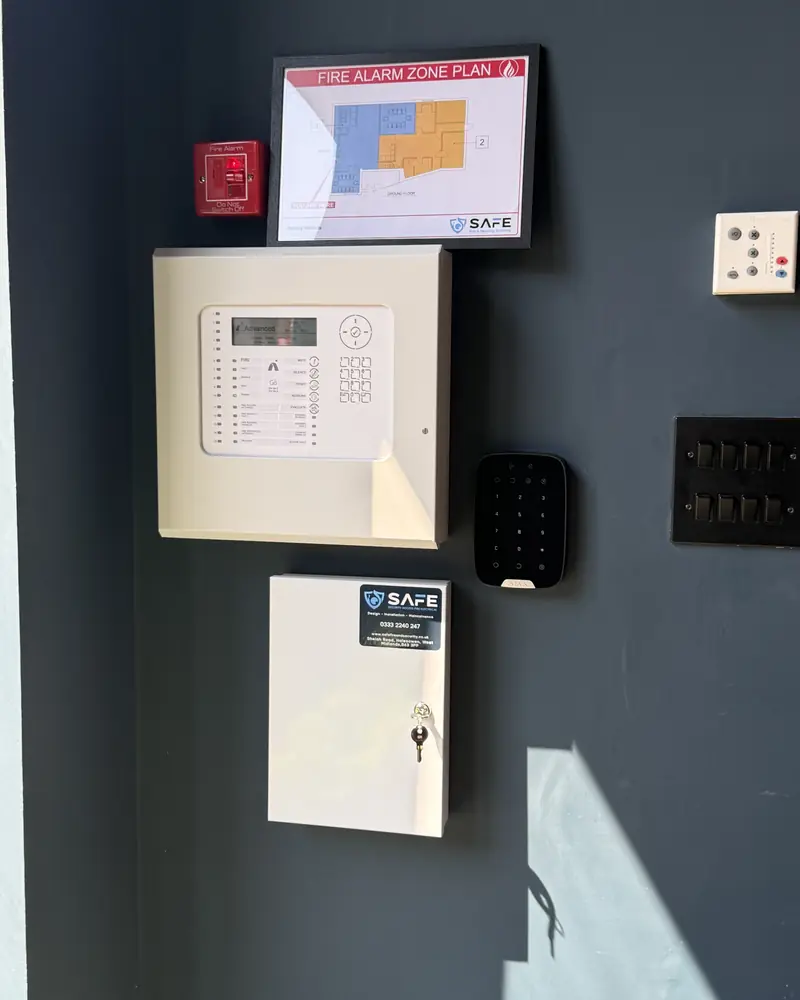
- Control panel: the brain of the system. It monitors every device, shows fires and faults, and lets you silence and reset the alarm.
- Detectors: smoke, heat, multi-sensor, beam or aspirating detectors, chosen to suit each area.
- Manual call points: the red “break glass” units by exits and on escape routes, so anyone who spots a fire can raise the alarm.
- Sounders and visual alarm devices: bells, sounders and flashing beacons that warn people, including anyone who is hard of hearing or in a noisy area.
- Power supplies and batteries: so the system keeps working in a power cut.
- Cabling or wireless links connecting it all together, using fire-resistant cable where it’s wired.
Conventional, addressable or wireless?
Conventional fire alarms
The building is split into zones, and the panel shows which zone the alarm came from, but not which device. Conventional systems are simple and suit smaller buildings, such as a single shop, a small office or a workshop. The downside is that finding the cause of an alarm or fault in a large zone takes longer.
Addressable fire alarms
Every device has its own address, so the panel tells you exactly which detector or call point has gone off, for example “first floor kitchen”. That makes faults and false alarms much quicker to find. Addressable systems also allow cause and effect programming, so different areas can respond in different ways. They’re the usual choice for larger or more complex buildings, such as schools, care homes, factories and multi-storey offices.
Wireless and hybrid fire alarms
Wireless systems use radio links instead of cables between devices. They’re quicker to fit and far less disruptive, which makes them a good fit for occupied buildings, finished interiors, listed buildings and temporary sites. Hybrid systems mix wired and wireless parts. Any wireless system used in a commercial building should meet EN 54-25, the European standard for radio-linked fire alarm components.
Which fire alarm system is right for your business?
| Conventional | Addressable | Wireless or hybrid | |
|---|---|---|---|
| Shows the exact device | No, zone only | Yes | Yes, on addressable wireless systems |
| Typical buildings | Small shops, offices, workshops | Schools, care homes, factories, larger offices | Occupied, listed or finished buildings |
| Cabling | Wired | Wired loops | Little or none between devices |
| Disruption to fit | Moderate | Moderate | Low |
Open protocol or proprietary?
Whichever type you choose, ask whether the panel and devices are open protocol or proprietary. With a proprietary system, only the company that fitted it, or its approved partners, can get the parts, software or passwords needed to service it, which can make changing provider later harder and more costly. Open protocol equipment can be serviced by any competent fire alarm company. Before you agree to a system, ask which panel is being proposed and whether you’d be free to switch maintenance company in future. Our own experienced engineers work on both open and closed protocol systems, so whichever you choose, we can service, maintain and extend it. Our guide to open protocol vs closed protocol fire alarms explains the difference in more detail.
BS 5839-1 categories explained
BS 5839-1:2025 sets out categories based on what the system is there to protect.
- Category M: manual only, using call points. People raise the alarm themselves.
- Category L (life protection): automatic detection to protect people.
- L1: detection throughout the building.
- L2: detection on escape routes plus rooms with a higher fire risk.
- L3: detection on escape routes plus rooms that open onto them.
- L4: detection on escape routes only.
- L5: detection in specific areas to deal with a particular risk.
- Category P (property protection): detection to protect the building and its contents.
- P1: detection throughout the building.
- P2: detection in specific areas only.
Your fire risk assessment should say which category you need, and insurers sometimes ask for a P category too. If you don’t have a fire risk assessment yet, we partner with select, highly experienced fire risk assessors we know and trust. For more on the standard, read our plain-English guide to BS 5839-1.
Fire alarm monitoring
A monitored fire alarm sends a signal to an alarm receiving centre (ARC) the moment it activates, so someone acts even when the building is empty. Monitoring is often expected for sleeping risks such as care homes, and many insurers ask for it in the policy small print.
Signals usually travel over dual-path connections, a broadband or network path backed up by a mobile path, so the alarm still gets through if one line fails. Many people know this as Redcare-style signalling. We monitor fire alarms through EMCS, an NSI Gold alarm receiving centre. See alarm monitoring.
Testing and servicing
- Every week: test a different manual call point and write it in the logbook.
- About every six months: a service by a competent engineer, between 5 and 7 months after the last one.
- Over each year: every detector and call point tested, and the zone plan checked against the building.
Our guide to how often fire alarms should be tested walks through the weekly test step by step.
What affects the cost of a commercial fire alarm?
We don’t publish prices, because every building is different, but these are the things that make the biggest difference:
- The size and layout of the building, and how many floors and rooms need covering.
- The category required by your fire risk assessment.
- The type of system: conventional, addressable, wireless or hybrid.
- How easy it is to run cables, and whether the building is occupied or listed.
- Extras such as monitoring, door holders, ventilation shutdown or interfaces with other systems.
- Whether parts of an existing system can be kept.
A free site survey is the quickest way to get accurate costs for your building.
For more detail, see our guide to what affects fire alarm installation cost.
Commercial fire alarm systems: your questions answered
What is a commercial fire alarm system?
It’s a fire detection and alarm system for a non-domestic building such as an office, shop, factory, school or care home. It includes a control panel, detectors, call points and sounders, and should be designed, installed and maintained to BS 5839-1.
What is the difference between conventional and addressable fire alarms?
A conventional system tells you which zone an alarm came from. An addressable system tells you exactly which device, which makes faults and false alarms much quicker to find and suits larger buildings.
Are wireless fire alarms suitable for commercial buildings?
Yes, as long as the components meet EN 54-25 and the system is designed to BS 5839-1. Wireless systems are often a good fit for occupied, finished or listed buildings because they need far less cabling.
Which fire alarm category does my business need?
Your fire risk assessment should set the category. Many commercial buildings need an L category to protect people, and some insurers also ask for a P category to protect the property.
What fire alarm does my business need?
It depends on the size and layout of your building, who uses it and what your fire risk assessment says. Most businesses need a system designed to BS 5839-1, with the category set by the fire risk assessment. We partner with select, highly experienced fire risk assessors we know and trust if you need one. Our free site survey will tell you whether a conventional, addressable or wireless system suits your building best.
Does a commercial fire alarm need to be monitored?
Not always, but it’s often expected for buildings where people sleep, such as care homes, and many insurers require it. Monitoring means an alarm receiving centre is told straight away, even when the building is empty.
How often should a commercial fire alarm be serviced?
BS 5839-1 recommends a service by a competent engineer about every six months, with a window of 5 to 7 months, plus a weekly call point test by you or your staff.
Who can install a commercial fire alarm?
A competent fire alarm company. Third-party approval from BAFE or NSI shows that a company’s fire alarm work is independently inspected.
Need a fire alarm system for your business?
We design, install and maintain commercial fire alarm systems from our base in Halesowen, using our own experienced engineers. We’re BAFE and NSI approved, and we look after commercial buildings across Birmingham, the Black Country, Worcestershire, Warwickshire, Staffordshire and Shropshire. See our business fire alarm installation service.
Book your free site survey. It’s a short, non-invasive visit: we’ll see what’s needed, guide you to a compliant solution and give you costs. No obligation and no hard sell.
Book your free site survey · Call 0333 224 0247 · enquiries@safefireandsecurity.co.uk