Emergency lighting installation and testing in Birmingham
Self-contained emergency lighting for Birmingham offices, workshops, schools, shops and warehouses: installed, tested and logged by our own engineers. When the power fails, your people can see the way out, and when a fire officer or insurer asks, your records are ready.
- Free site survey, no obligation
- Monthly and annual tests carried out by our own engineers
- Designed and tested to BS 5266-1:2025
- Breakdown cover on maintenance contracts
Accredited & approved



Emergency lighting is the bit that gets forgotten
In a power cut or a fire, the normal lights go out and escape routes go dark. Emergency lighting is meant to come on by itself and keep the way out lit. The trouble is, you won't know a fitting has failed until it matters, or until someone asks for the test records. These are the problems we see most often in Birmingham buildings:
- Monthly tests that stopped months ago, with nothing written in the logbook.
- Fittings that light up for a minute, then fade, because the batteries are worn out.
- A refit or new partition walls that left part of an escape route without emergency lighting.
- Old fluorescent fittings that keep failing and are expensive to keep running.
What the law and the standard expect
Under the Regulatory Reform (Fire Safety) Order 2005, emergency routes and exits that need lighting must have emergency lighting of adequate intensity if the normal lighting fails. The responsible person has to make sure it's in place, maintained and tested. In Birmingham, West Midlands Fire Service enforces the law and can inspect your premises.
BS 5266-1 is the code of practice for emergency lighting of premises. The current edition, BS 5266-1:2025, came into effect on 31 October 2025 and replaced the 2016 edition. In plain terms it recommends:
- A monthly functional test of every fitting, to check it comes on when the mains supply is cut.
- An annual full-duration test, running each fitting on its battery for its full rated time (often three hours), to prove the batteries still last.
- Checking light levels at commissioning and at least every five years, to confirm escape routes are still lit well enough.
- A logbook recording every test, fault and repair.
The 2025 edition also asks for minimum light levels at things people need to find in the dark, such as fire extinguishers, fire alarm call points and panels, and first aid points. Your fire risk assessment should say what your building needs, and our guide to the responsible person's duties explains who has to make sure it happens. No fire risk assessment yet? We partner with select, highly experienced fire risk assessors we know and trust. See fire risk assessments in Birmingham.
Self-contained emergency lighting, done properly
Every fitting we install has its own battery and charger built in, so each one works independently. That keeps the system simple to extend, test and repair.
- Maintained fittings stay lit all the time and keep going in a power cut. Common in places of entertainment, shops and anywhere the lights may be dimmed.
- Non-maintained fittings only come on when the power fails. The usual choice for offices, workshops and warehouses.
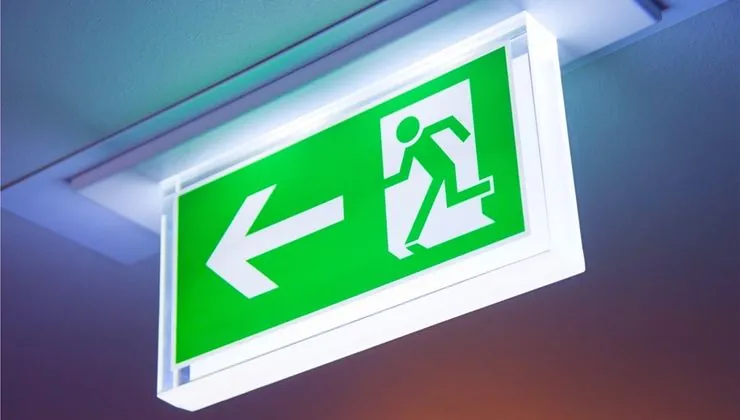
- Exit signs, lit so the way out can be seen in the dark.
- Escape route, open area and high-risk task lighting, matched to each part of the building: corridors and stairs, large open rooms, and areas such as plant rooms and kitchens where work needs to be shut down safely.
- Modern LED fittings, which last longer and use less power than old fluorescent ones.
- Self-test fittings, which run their own tests and flag faults, to make record keeping easier in larger buildings.
Testing that's done for you
Most building managers don't have time to chase emergency lighting tests. We take it off your list.
- Monthly tests carried out and logged by our own engineers.
- Annual full-duration tests planned for when your building is quiet, because batteries need time to recharge afterwards.
- Faults fixed: failed lamps, batteries and fittings replaced, with repairs quoted separately.
- Records online in your customer portal, ready for your fire risk assessor, insurer or a fire officer.
- Combined visits: we can test your emergency lighting on the same visits as your fire alarm and fire extinguishers.
Already looking after Birmingham buildings
At The Hollymoor Centre in Northfield, a charity-run education centre with a nursery, we look after the emergency lighting, fire alarm and fire extinguishers, with every visit documented so the team can see what was tested and when. Read the Hollymoor case study.
In the Jewellery Quarter, we look after the fire alarm, fire extinguishers, CCTV and access control at Assay Studios, a Grade II listed, multi-tenant building on Newhall Street. See fire alarms in Birmingham.
"Give them a call, get them to your site, do the site survey. As soon as I met you and your team, I was sold." Building Manager, Assay Studios, Jewellery Quarter
Birmingham buildings we work in
- Offices in the city centre, Colmore Business District, Edgbaston and Brindleyplace.
- Workshops and studios in the Jewellery Quarter and Digbeth, often in older buildings that have been split into smaller units.
- Warehouses and industrial units in Tyseley, Aston, Witton, Erdington and Longbridge, where open areas and high-risk task areas need the right lighting.
- Schools, academies and nurseries, with enhanced DBS-checked engineers and installs planned for the school holidays.
- Shops, restaurants and leisure venues, with testing booked around opening hours.
- Care homes and healthcare, with careful planning around residents and patients.
- Churches, charities and community buildings, with clear options planned around the budget.
How it works
- Free site survey. A short, non-invasive visit. We look through your test records or see what you need, guide you to a compliant solution and give you costs. We don't test or open up any equipment.
- Clear, written plan. New fittings, upgrades or us taking over testing, set out clearly before any work starts.
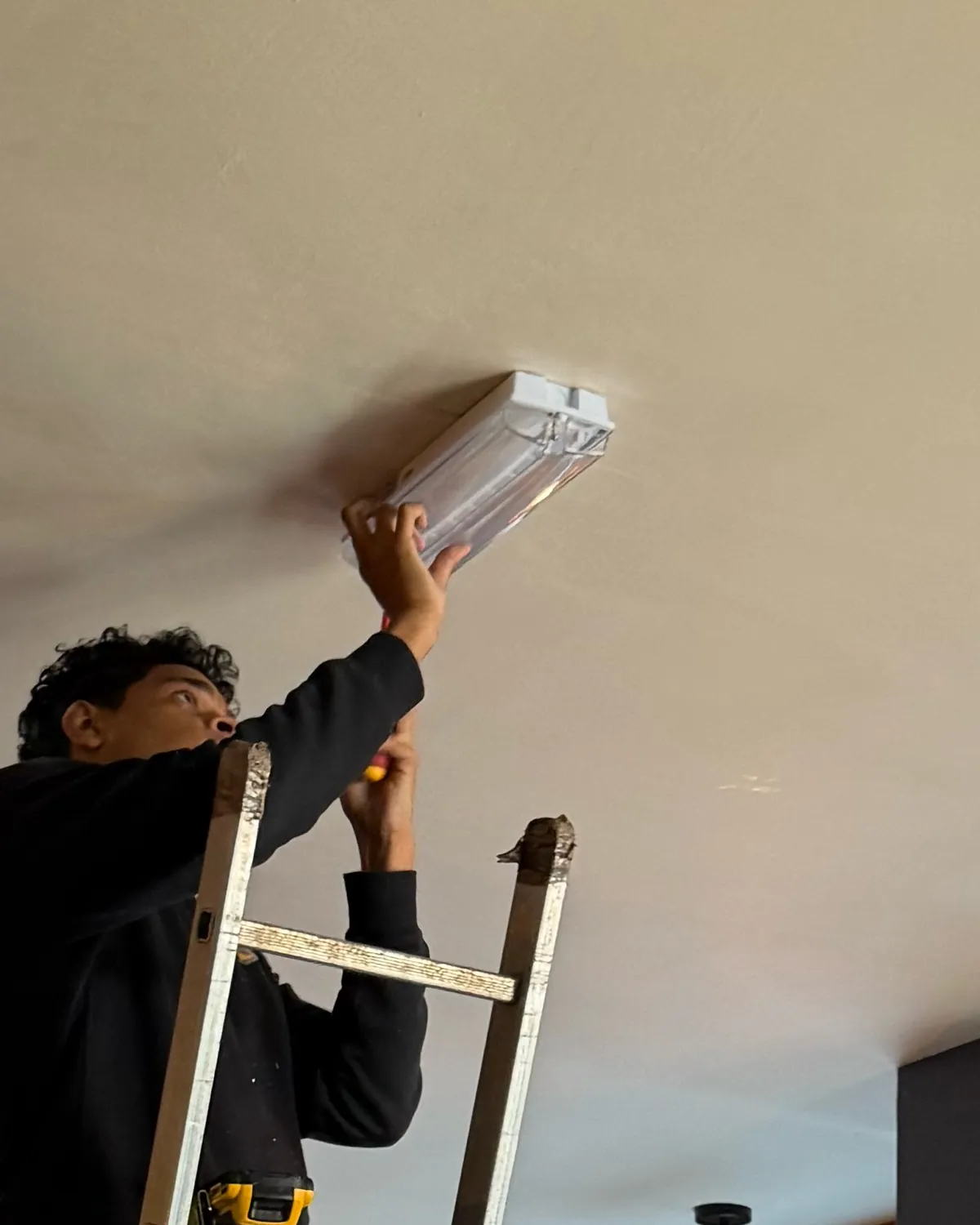
- Install or take over. Our own engineers fit or take on the system, and test and log it from then on.
- Looked after. Monthly and annual tests booked in, faults fixed and records online.
Covering the whole of Birmingham
The city centre, Jewellery Quarter, Digbeth, Edgbaston, Harborne, Quinton, Selly Oak, Bournville, Northfield, Longbridge, Kings Heath, Hall Green, Acocks Green, Yardley, Tyseley, Small Heath, Aston, Witton, Perry Barr, Erdington and Sutton Coldfield. We're based in Halesowen, just over the city boundary, and also cover the Black Country, Solihull and the wider West Midlands.
Need a fire alarm too? See fire alarm installation. More on our emergency lighting service.
Closer to our office? See emergency lighting in Halesowen.
Emergency lighting in Birmingham: your questions answered
How often does emergency lighting need testing?
Is emergency lighting a legal requirement for my business?
What changed in BS 5266-1:2025?
What's the difference between maintained and non-maintained emergency lighting?
Can you replace our old fluorescent emergency lights with LED?
Can you take over testing from our current company?
What happens if a light fails between visits?
Keep your way out lit
Book your free site survey anywhere in Birmingham. No obligation and no hard sell.
SAFE Fire & Security Systems Ltd, La Husbands, Shelah Road, Halesowen, West Midlands, B63 3PP. Office open Monday to Friday, 8:30am to 5pm. Breakdown cover on maintenance contracts.
SAFE Fire & Security Systems Ltd, La Husbands, Shelah Road, Halesowen, West Midlands, B63 3PP · Office open Monday to Friday, 8:30am to 5pm. Breakdown cover on maintenance contracts.