
If you’re responsible for a commercial building in England or Wales, the law expects your escape routes to be lit when the mains power fails, and it expects that lighting to be tested and kept in working order. In practice that means emergency lighting designed to BS 5266-1, a quick functional test every month, a full-duration test every year and a logbook that records it all. This guide explains what the regulations say, how often emergency lighting should be tested, what goes on the certificate and what to do when a fitting fails.
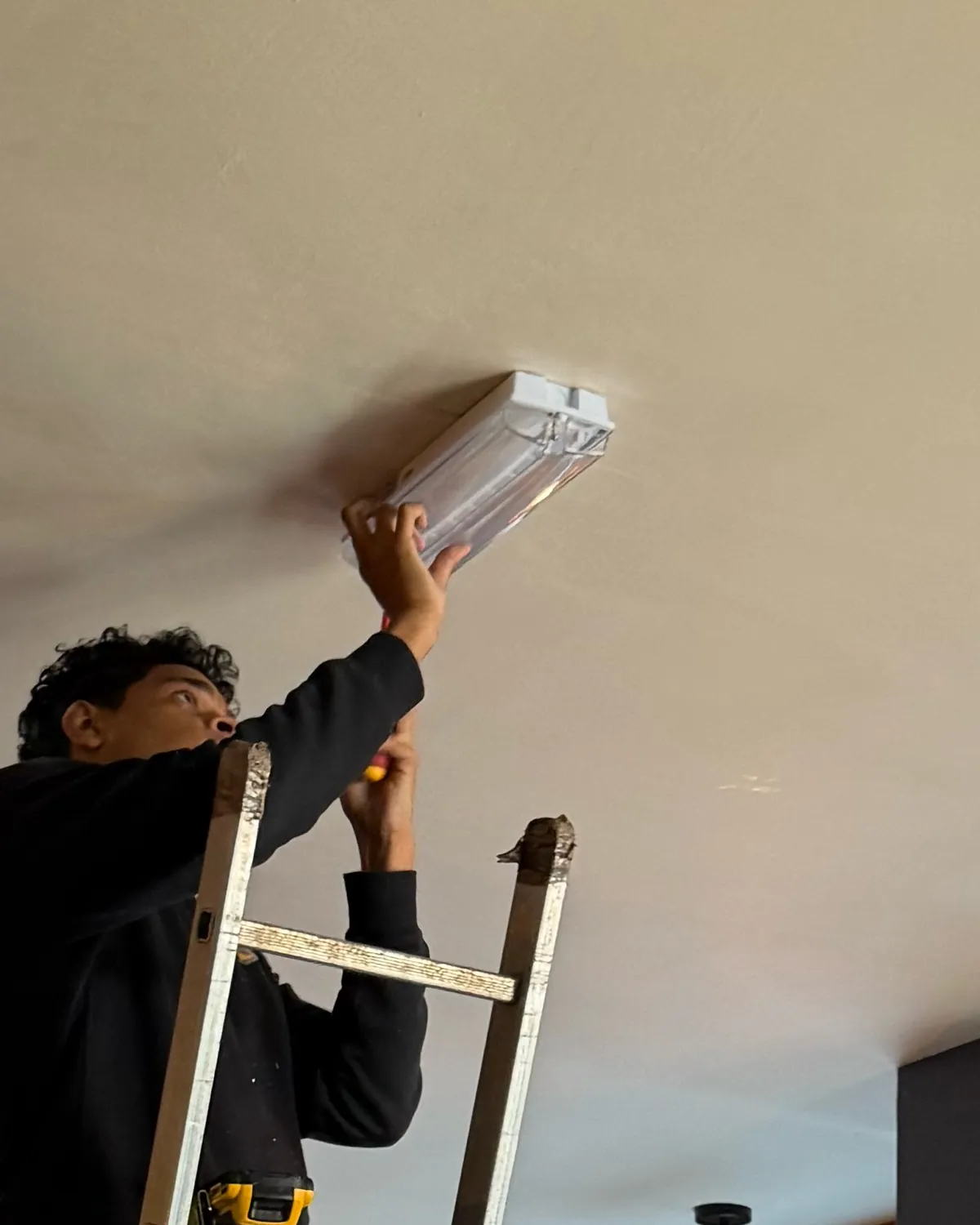
What do the emergency lighting regulations say?
There isn’t a single “emergency lighting act”. The duty comes from fire safety law, and the detail comes from British and European standards.
- The Regulatory Reform (Fire Safety) Order 2005 applies to almost all non-domestic premises in England and Wales. It says emergency routes and exits must be indicated by signs, and that emergency routes and exits needing illumination must have emergency lighting of adequate intensity in case the normal lighting fails. It also requires fire safety equipment, including emergency lighting, to be maintained in efficient working order.
- BS 5266-1 is the code of practice for emergency lighting of premises. It covers where emergency lighting is needed, how it should be designed, and how it should be tested, recorded and certificated. It’s the benchmark fire officers, insurers and fire risk assessors use.
- BS EN 1838 sets the lighting levels, and BS EN 50172 sets out the testing and record-keeping routine.
The person who has to make sure all of this happens is the Responsible Person, usually the employer, the business owner or whoever controls the building. If you’re not sure whether that’s you, our guide to the Responsible Person and their legal duties explains it.
Where is emergency lighting needed?
Your fire risk assessment should identify where emergency lighting is needed. As a guide, BS 5266-1 expects it to cover:
- every escape route, including corridors, stairways and changes of direction or floor level
- each final exit door, and outside it as far as a place of safety
- near each fire alarm call point and each piece of firefighting equipment, such as extinguishers
- exit and safety signs, so they can still be seen
- toilets for disabled people and any toilet without borrowed light
- lift cars, plant rooms, switch rooms and other areas staff may need to reach in a power cut
- large open areas where people could panic in the dark (often called open area or anti-panic lighting)
- high-risk task areas, where someone needs to make a machine or process safe before leaving
What lighting levels does the standard expect?
BS EN 1838 sets minimum light levels for when the emergency lighting is running:
- Escape routes: at least 1 lux along the centre line of the route (for routes up to 2 m wide).
- Open areas: at least 0.5 lux across the floor, excluding a border around the edge.
- High-risk task areas: at least 10% of the normal lighting level, and not less than 15 lux.
These levels are why emergency lighting needs proper design. Fittings placed by eye can leave dark patches between them, especially on stairs and at corners.
Maintained vs non-maintained emergency lighting
You’ll often see emergency light fittings described as maintained or non-maintained:
- Non-maintained: the fitting stays off while the mains supply is on and only lights up when the power fails. This is the most common type in offices, warehouses and industrial units.
- Maintained: the fitting is lit all the time and stays lit when the power fails. It’s typically used where people may not know the building and where the normal lights may be dimmed, such as theatres, cinemas, bars and other entertainment venues, and for many illuminated exit signs.
- Sustained (combined): a fitting with two lamps, one powered by the mains and one that lights from its battery when the power fails.
We design, install and maintain self-contained emergency lighting, where each fitting has its own battery and charger. It’s simple to extend, easy to test and a failed fitting affects only itself.

How often should emergency lighting be tested?
BS 5266-1 and BS EN 50172 set out a simple routine:
| How often | What happens | Who can do it |
|---|---|---|
| Daily (where there’s a central control or indicator panel) | Check that indicators show the system is healthy | A nominated member of staff |
| Monthly | A short functional test: simulate a mains failure and check every fitting and sign lights up, then restore the supply and check the charge indicators | A competent nominated person, or your maintenance company |
| Every 12 months | A full rated-duration test (usually 3 hours), plus an inspection of every fitting and a check that the system still suits the building | A competent person, such as an emergency lighting engineer |
Every test, fault and repair should go in the emergency lighting logbook.
The monthly test
The monthly test (often called a flick test) checks that each fitting switches over to battery when the mains fails. It only needs to run long enough to see that every lamp is lit, so the batteries aren’t drained. Most modern fittings have a test key switch, so the light circuit can be tested without turning off the building’s lighting.
The annual full-duration test
Once a year, every fitting should run on its battery for its full rated duration. Most commercial premises need 3-hour emergency lighting. A 1-hour duration is only acceptable in some premises, where the building is evacuated straight away and isn’t reoccupied until the normal lighting is back, and your system design should say which applies.
The annual test is what shows up tired batteries. A fitting can pass every monthly test and still fail after 40 minutes on a full discharge.
After a full-duration test, the batteries need time to recharge, and the building has reduced emergency lighting until they do. That’s why annual tests are best planned for quieter times, or done on alternate fittings over separate visits, so the building is never left without cover.
Self-testing emergency lighting
Self-test fittings run their own monthly and annual tests and show a fault on an indicator, or report it to a monitoring system. They cut down on routine site work, but someone still needs to check the results, record them in the logbook and arrange repairs.
Emergency lighting certificates and the logbook
BS 5266-1 includes model certificates. The ones you’ll come across most are:
- Completion certificate: issued when a new system or an extension is installed and commissioned, confirming it has been designed, installed and tested to the standard.
- Periodic inspection and test certificate: issued after the annual inspection and full-duration test, recording the results and any faults found.
- Logbook: the ongoing record of every monthly and annual test, every fault and every repair or alteration.
Your fire risk assessor, the fire and rescue service or your insurer may ask to see these. If you can’t show a current certificate and an up-to-date logbook, it’s difficult to prove your emergency lighting is being maintained. Our maintenance customers can see their certificates and service reports in our customer portal.
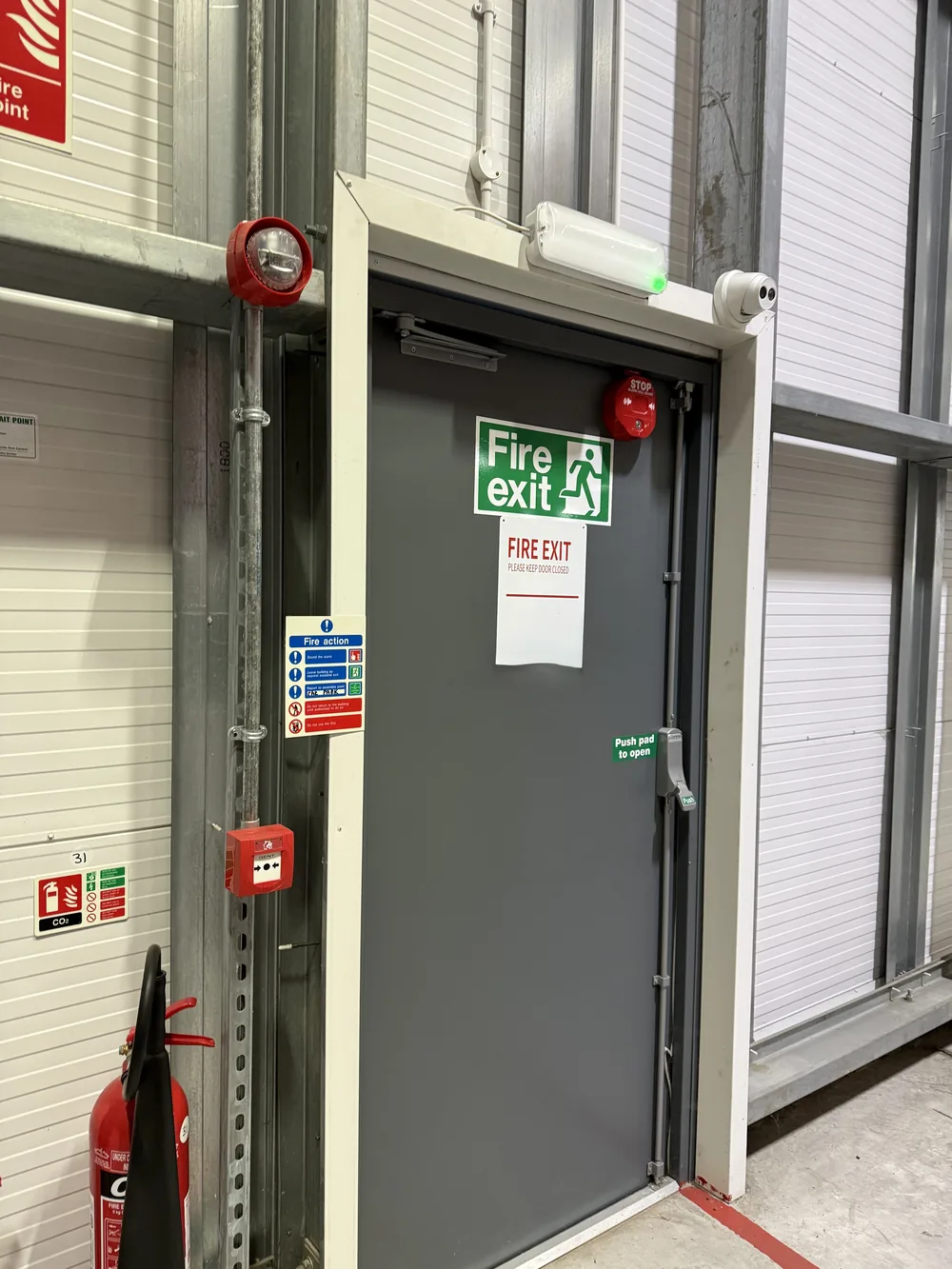
Emergency lighting faults and repairs
Most emergency lighting failures are simple, but they only show up if someone tests for them. The most common faults are:
- batteries that no longer last the full duration
- failed lamps or LED modules
- charge indicators that are off, usually a supply or charger fault
- fittings painted over, damaged or blocked by shelving and stock
- fittings removed or moved during a refit and never replaced
- exit signs pointing the wrong way after a layout change
When we find a fault, we’ll tell you what’s failed, why it matters and what it’ll take to put it right, and we’ll record it in your logbook. Where a system has been extended piecemeal over the years, it’s often worth reviewing the whole layout rather than replacing fittings one at a time.
Emergency lighting and your fire risk assessment
Your fire risk assessment should consider whether your emergency lighting is suitable for the building and how it’s used. If the building changes, for example a new mezzanine, a new layout or longer opening hours, the emergency lighting may need to change too.
We partner with select, highly experienced fire risk assessors we know and trust, so if you need an assessment as well, we can help you get one booked. See our fire risk assessments in Birmingham page.
A quick emergency lighting checklist
- Do you know who carries out your monthly tests, and are they recorded?
- Has every fitting had a full-duration test in the last 12 months?
- Do you have a current periodic inspection and test certificate?
- Is every escape route, exit door and call point covered?
- Has anything changed in the building since the system was designed?
- Are any charge indicators off, or any fittings damaged or blocked?
If you’ve answered “no” or “not sure” to any of these, it’s worth getting the system checked.
How SAFE can help
Our own experienced engineers design, install, test and maintain self-contained emergency lighting for commercial buildings across Birmingham and the West Midlands, and we can take over systems fitted by other companies.
- New systems and upgrades: emergency lighting installation and testing to BS 5266-1.
- In Birmingham: emergency lighting in Birmingham.
- The wider picture: fire safety in the workplace and how often fire alarms should be tested.
Call 0333 224 0247 or contact us to book a free site survey.
Frequently asked questions
Is emergency lighting a legal requirement for businesses?
Yes, in most cases. The Regulatory Reform (Fire Safety) Order 2005 requires emergency routes and exits that need illumination to have emergency lighting in case the normal lighting fails, and requires it to be kept in working order. BS 5266-1 is the code of practice used to show you’ve met that duty.
How often should emergency lighting be tested?
Every month with a short functional test to check each fitting lights up when the mains fails, and every 12 months with a full rated-duration test, usually 3 hours, plus an inspection. Every test should be recorded in the emergency lighting logbook.
Can I do the monthly emergency lighting test myself?
Yes, a competent nominated person can carry out the monthly functional test, as long as they know how to do it safely and record the results. The annual full-duration test and inspection should be done by a competent person, such as an emergency lighting engineer.
What is BS 5266-1?
BS 5266-1 is the British Standard code of practice for emergency lighting of premises. It covers where emergency lighting is needed, how it should be designed, and how it should be tested, recorded and certificated.
What is the difference between maintained and non-maintained emergency lighting?
Non-maintained fittings only light up when the mains power fails. Maintained fittings are lit all the time and stay lit when the power fails, and are typically used in places like theatres, cinemas and bars, and for many illuminated exit signs.
What certificate do I need for emergency lighting?
A completion certificate when a new system or extension is installed, and a periodic inspection and test certificate after each annual inspection and full-duration test, together with an up-to-date logbook of monthly tests, faults and repairs.
How long should emergency lighting last?
Most commercial premises need emergency lighting rated for 3 hours. A 1-hour duration is only acceptable in some premises, where the building is evacuated straight away and not reoccupied until the normal lighting is restored. Your system design should say which applies.
Leave a comment