
Fire doors are one of the cheapest life-safety measures in a building, and one of the most neglected. They get wedged open, kicked, drilled for new locks and painted over, and most of that damage is easy to spot if you know what to look for. This guide covers what the law expects from fire doors in commercial premises, how often they should be inspected, a simple checklist you can use between inspections, and when it’s time to bring in a professional fire door inspection.
At a glance
- Fire doors hold back fire and smoke so people can get out and firefighters can get in. A damaged door can fail in minutes.
- In commercial buildings the Regulatory Reform (Fire Safety) Order 2005 makes the Responsible Person keep fire doors in efficient working order and good repair.
- BS 8214 is the code of practice for installing and maintaining timber fire door assemblies, and it’s what a professional inspection works to.
- There’s no single legal interval for commercial premises. Your fire risk assessment should set it, and busy doors need checking more often.
- Quick visual checks between inspections catch most problems: the closer, the gaps, the seals, the hinges, the signs, and whether the door is being propped open.
What does a fire door actually do?
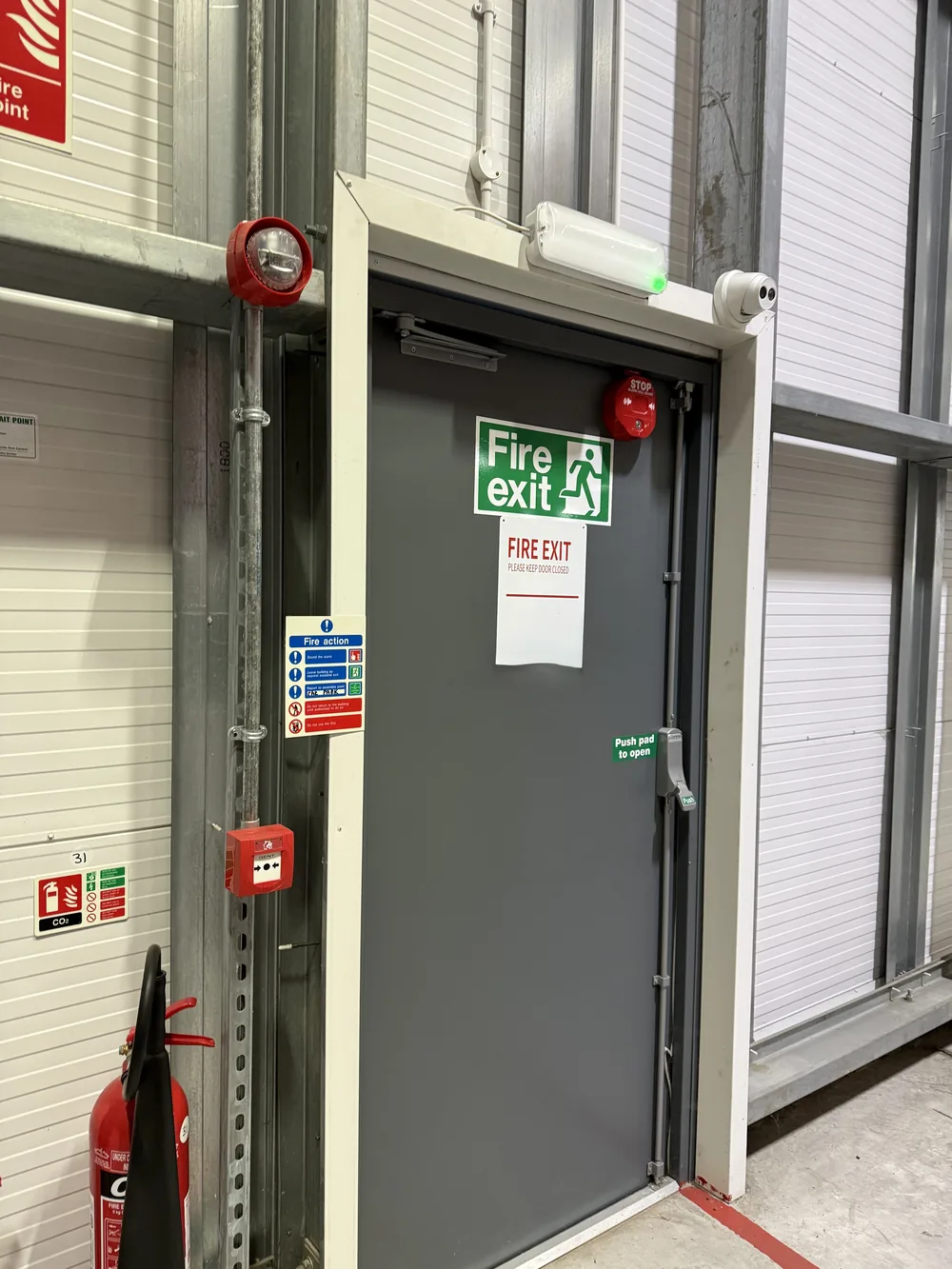
A fire door is a complete assembly: the door leaf, the frame, the hinges, the closer, the intumescent strips and smoke seals, any glazing, the locks and latches, and the signs. Each part is tested together. Change one part with the wrong product, such as a standard hinge or non-rated glass, and the whole door may no longer perform as tested.
Fire doors are rated by how long they resist fire in a test. An FD30 door is designed to hold back fire for 30 minutes and an FD60 for 60 minutes. An “S” on the end (FD30S) means the door also has smoke seals to limit cold smoke, which is often the bigger danger in the first few minutes of a fire.
Fire door regulations for commercial buildings
The Regulatory Reform (Fire Safety) Order 2005
The Fire Safety Order applies to almost all non-domestic premises in England and Wales: offices, shops, factories, warehouses, schools, care homes, hotels and the common parts of multi-let buildings. It puts the duty on the Responsible Person, usually the employer, owner or managing agent, to make sure fire safety measures, including fire doors, are maintained in efficient working order and in good repair.
Not sure who the Responsible Person is in your building? Our guide to the Responsible Person and their legal duties explains it.
Your fire risk assessment
Every Responsible Person must have a suitable and sufficient fire risk assessment, and it should say which doors are fire doors and how they’ll be checked. Fire doors are one of the most common action points we see on assessments. We partner with select, highly experienced fire risk assessors we know and trust, so if your assessment is out of date we can help you get it reviewed. See our fire risk assessment page.
Building Regulations Approved Document B
Approved Document B sets out where fire doors are needed when a building is built, extended or refurbished, for example on protected stairways and corridors, and between different uses in the same building. If you’re fitting out a unit or changing how a space is used, it’s worth checking whether new fire doors are needed.
The Building Safety Act 2022
Since 1 October 2023 every Responsible Person must record their fire risk assessment and fire safety arrangements in full. Records of fire door inspections and repairs are part of showing those arrangements are in place.
BS 8214
BS 8214 is the British Standard code of practice for timber-based fire door assemblies. It covers how they should be installed, inspected and maintained. A professional fire door inspection checks each door against it and against the manufacturer’s certification for that door.
How often should fire doors be inspected?
For commercial premises the law doesn’t fix a single interval. It says doors must be kept in good repair, and your fire risk assessment should set how often they’re checked. In practice:
- Busy doors on main escape routes, stairways and corridors take the most abuse and need checking more often, often every few months.
- Less used doors, such as plant room and riser cupboard doors, can usually be checked less often.
- A full professional inspection of every fire door, with a written record, is a sensible baseline at least once a year, with more frequent checks where your fire risk assessment calls for them.
- After any damage or alteration, such as a new lock, a door being re-hung or a forklift strike, the door should be checked before it’s relied on again.
Fire door inspection checklist
You don’t need to be an inspector to spot most problems. Walk your fire doors with this list. If anything fails, report it and get it looked at.
- Certification. Is there a label or plug, usually on the top edge or the hinge edge of the door, showing it’s a certified fire door? No label doesn’t always mean it isn’t a fire door, but it means it needs checking properly.
- Gaps. The gap between the door and the frame along the top and sides should typically be around 3 mm, and usually no more than 4 mm. The gap at the bottom is often allowed to be larger, but follow the door’s certification. If you can see daylight through the gap at the top or sides, it needs looking at.
- Intumescent strips and smoke seals. Are they all there, unbroken and not painted over? Intumescent strips expand in a fire to seal the gap. Painted or missing strips can’t do their job.
- Self-closer. Open the door fully, let go, and check it closes on its own and latches into the frame from any angle. A door that stops short or bounces open isn’t protecting anyone.
- Hinges. Are there at least three, all firmly fixed, with no missing screws, oil leaks or worn parts?
- Door leaf and frame. Look for holes, splits, damage from trolleys or forklifts, and old lock or letterbox holes that have been filled with the wrong material.
- Glazing. Is any glass intact, fire rated and firmly held in its beading?
- Signage. Is the right sign on both faces: “Fire door keep shut” on doors that stay closed, “Fire door keep locked” on cupboards and risers, and “Automatic fire door keep clear” on doors with hold-open devices?
- Wedges and hold-opens. Is the door being wedged or propped open? If it needs to stay open for day-to-day use, the right answer is a hold-open device that releases when the fire alarm goes off, not a wedge.
- Locks and handles. Do they work, and can the door be opened easily from the escape side without a key?
The most common faults we find
- Doors wedged open with fire extinguishers, bins or wedges.
- Closers removed or adjusted so the door doesn’t latch.
- Gaps that have grown as the building settled or the door dropped on its hinges.
- Intumescent strips painted over or missing after decorating.
- New locks, access control hardware or cable holes added without fire-rated parts or proper sealing.
- Missing or wrong signs.
Many of these are quick, low-cost fixes if they’re caught early. Left alone, they can mean replacing the whole door.
What a professional fire door inspection includes
At SAFE Fire & Security our fire door services for commercial premises include:
- Certified fire door inspections in line with BS 8214
- Asset tagging of each door and digital compliance reports with photographic records and clear action points
- Remedial works and maintenance for damaged or non-compliant doors
- Full replacement and installation of certified fire doors
- One-off inspections or annual servicing contracts
The report gives you a clear record for your fire safety arrangements and a straightforward list of what needs fixing. We give honest advice and cost-effective remedial options, and we’ll tell you when a repair makes more sense than a new door. See our fire door services page for more.
Fire doors are part of a bigger system
Fire doors work alongside your fire alarm, emergency lighting and escape routes. If doors are held open on magnetic hold-opens, they need to release when the alarm sounds. If your escape routes rely on doors that are kept shut, your emergency lighting needs to light them. That’s why we look after the whole picture for many of our customers: fire alarm servicing and maintenance, emergency lighting and fire doors, with one team and one set of records. Our guide to life safety systems explains how they fit together, and our workplace fire safety guide covers the rest of your duties.
Book a fire door inspection
We look after commercial buildings across Birmingham, the Black Country, Worcestershire, Warwickshire and the wider West Midlands. See the areas we cover. Call us on 0333 224 0247 or get in touch to book a free site survey.
FAQs
Is a fire door inspection a legal requirement?
In commercial premises the Fire Safety Order requires the Responsible Person to keep fire doors in efficient working order and good repair. The law doesn’t name a specific inspection, but regular inspections with written records are the normal way to show you’re meeting that duty, and your fire risk assessment will usually call for them.
How often should fire doors be inspected?
There’s no single legal interval for commercial buildings. Your fire risk assessment should set it. Busy doors on escape routes need checking more often than rarely used ones, and a full professional inspection with a written record at least once a year is a sensible baseline.
Who can carry out a fire door inspection?
The Responsible Person or a trained member of staff can do simple visual checks between inspections. A full inspection should be done by a competent person who knows BS 8214 and fire door certification, and who can give you a written report.
What gap should there be around a fire door?
The gap at the top and sides is typically around 3 mm, and usually no more than 4 mm. The gap at the bottom is often allowed to be larger. Always check against the door’s own certification, because the allowed gaps can differ between door types.
Can a fire door be wedged open?
No. A wedged fire door can’t stop fire or smoke. If a door needs to stay open for everyday use, fit a hold-open device that releases the door automatically when the fire alarm sounds.
Can I fit a new lock or access control to a fire door?
Only with fire-rated hardware fitted correctly, and with any holes properly sealed. Cutting into a fire door for new hardware without the right parts can stop it performing as tested. Get it checked afterwards.
What happens after a fire door inspection?
You get a report for each door showing whether it passes and what needs doing. We can then quote for any remedial work or replacement doors, and set up regular inspections so the records stay up to date.
Leave a comment