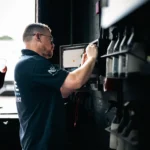
Fixed wire testing is the inspection and testing of a building’s fixed electrical installation, and the result is an Electrical Installation Condition Report (EICR). No law names the EICR or sets a date, but the Electricity at Work Regulations 1989 require businesses to keep their electrics safe, and a periodic EICR is the accepted way to show you’re doing it. This guide explains what that means for commercial and public buildings, how often you need a test, what the report codes mean and how to plan the work with as little disruption as possible.
What is fixed wire testing (EICR)?
Fixed wire testing is an inspection and test of the electrical installation that is fixed in place in a building, carried out to BS 7671, and it ends with an Electrical Installation Condition Report (EICR).
“Fixed wire testing”, “fixed wiring inspection”, “periodic inspection” and “EICR” all describe the same job. A qualified electrician inspects and tests the parts of your electrical installation that are fixed in place:
- the incoming supply, distribution boards and consumer units
- the circuits and cables running from them
- sockets, switches and light fittings
- fixed equipment wired straight in, such as hand dryers, water heaters and some machinery
- earthing and bonding
The work is carried out against BS 7671, the IET Wiring Regulations. At the end you get an EICR, which says whether the installation is satisfactory for continued use and lists anything that needs attention.
Fixed wire testing is not the same as PAT testing. PAT testing covers portable and plug-in equipment, such as computers, kettles, extension leads and plug-in 3 phase machines. Most businesses need both. See our PAT testing service for the plug-in side.
Is an EICR a legal requirement for businesses?
There’s no regulation that says “every business must have an EICR every five years”. The legal duty is broader than that.
The Electricity at Work Regulations 1989
The Electricity at Work Regulations 1989 apply to almost every workplace. They require electrical systems to be constructed and maintained so as to prevent danger, so far as reasonably practicable. The duty sits with employers and with whoever controls the premises, so it applies to business owners, facilities managers and managing agents alike.
The regulations don’t say how you should show the installation is maintained. In practice, a periodic EICR carried out to BS 7671 is the accepted way to do it. If there’s an electrical accident or fire, a current report with the remedial work signed off is the clearest evidence you’ve done what the law asks.
Other reasons you’ll be asked for one
- Insurers. Many commercial policies expect a current EICR, and some ask for it at renewal or after a claim.
- Fire risk assessments. Electrical faults are a common cause of workplace fires, so your fire risk assessment will look at how your electrics are maintained. For assessments, we partner with select, highly experienced fire risk assessors we know and trust. See fire risk assessments in Birmingham.
- Leases and property sales. Building owners, managing agents, buyers and their surveyors often ask for the latest report.
- Audits and tenders. Schools, care homes and contractors bidding for work are regularly asked to show their electrical records.
How often does a business need fixed wire testing?
IET guidance recommends maximum intervals between inspections based on the type of premises. For example:
- Offices and shops: up to five years.
- Industrial premises, such as factories and workshops: up to three years.
These are maximums, not targets. The electrician who carries out the inspection can recommend a shorter interval if the installation is old, heavily used, damp, dusty or showing wear, and the next due date will be written on your report. You should also have an inspection when you take on new premises, change how a building is used, or after damage such as a flood or fire.
How long is an EICR valid for?
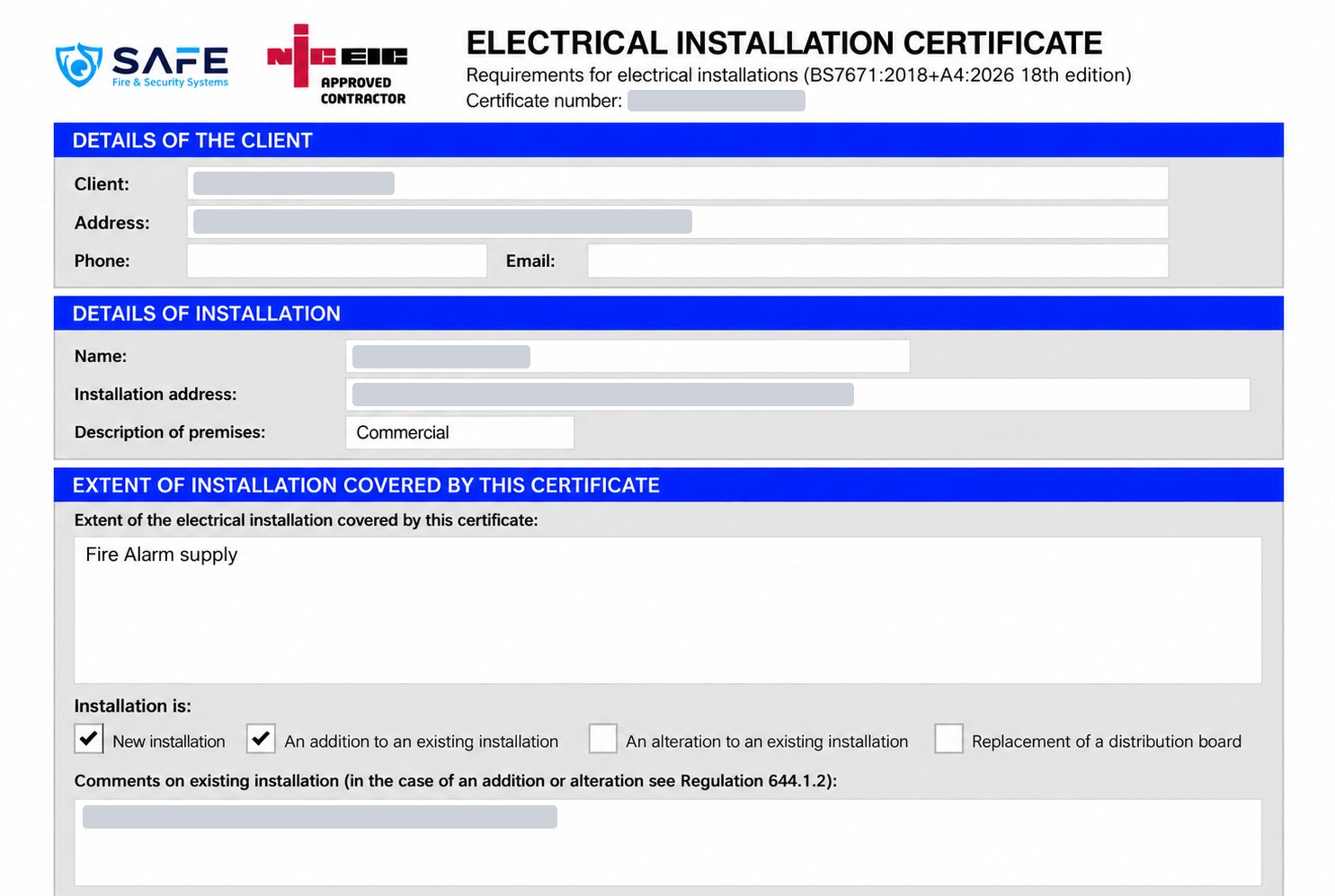
An EICR doesn’t expire on a fixed date. It records the condition of the installation on the day it was tested and recommends when the next inspection is due. So an EICR “lasts” until that date, provided nothing significant changes. If you add circuits, alter the layout or have a fault, the report no longer reflects the whole installation, and the new work should come with its own certificate.
Fixed wire testing for commercial premises
Every commercial building has its own pressure points, so we plan the inspection around how you use it:
- Offices and multi-let buildings: testing floor by floor or out of hours so tenants keep working. In shared buildings, check your lease for who is responsible for the building owner’s supply and common parts and who looks after each tenant’s own installation.
- Shops and retail units: testing before opening or after closing, with tills, lighting and refrigeration planned around.
- Factories, workshops and warehouses: 3 phase supplies, machinery wired straight in and dusty or damp areas, which is why the guidance interval is shorter.
- Schools: testing planned for holidays and closure days where possible.
- Care homes: circuits that can’t lose power, such as nurse call, medical equipment and kitchens, agreed before we start.
We carry out commercial EICRs across Birmingham and the West Midlands. See EICR testing in Birmingham.
EICR codes explained: C1, C2, C3 and FI
Every item the inspector records is given a code, so you can see at a glance what needs doing and how urgently.
| Code | Meaning | What happens next |
|---|---|---|
| C1 | Danger present. Risk of injury. | Immediate action is needed. The inspector will usually make it safe on the day, for example by isolating the circuit. |
| C2 | Potentially dangerous. | Urgent remedial action is needed. |
| C3 | Improvement recommended. | Not dangerous, but worth doing, often when other work is planned. |
| FI | Further investigation needed. | Something needs looking at more closely, without delay. |
Any C1, C2 or FI means the report is unsatisfactory until the work is done. C3 items on their own don’t make a report unsatisfactory. Once the remedial work is complete, you’ll get certificates for it, and those sit with the EICR as your record.
At SAFE, any repairs or remedial work the report finds are quoted separately, so nothing is done without your say-so. Our own engineers can then carry out the work and certify it.
What happens during fixed wire testing?
- Survey and plan. We look at the size of the installation, the number of distribution boards and circuits, and how the building is used, then agree which areas will be tested when.
- Visual inspection. We check boards, cables, accessories and fixed equipment for damage, overheating, missing covers, wrong cable sizes and signs of DIY alterations.
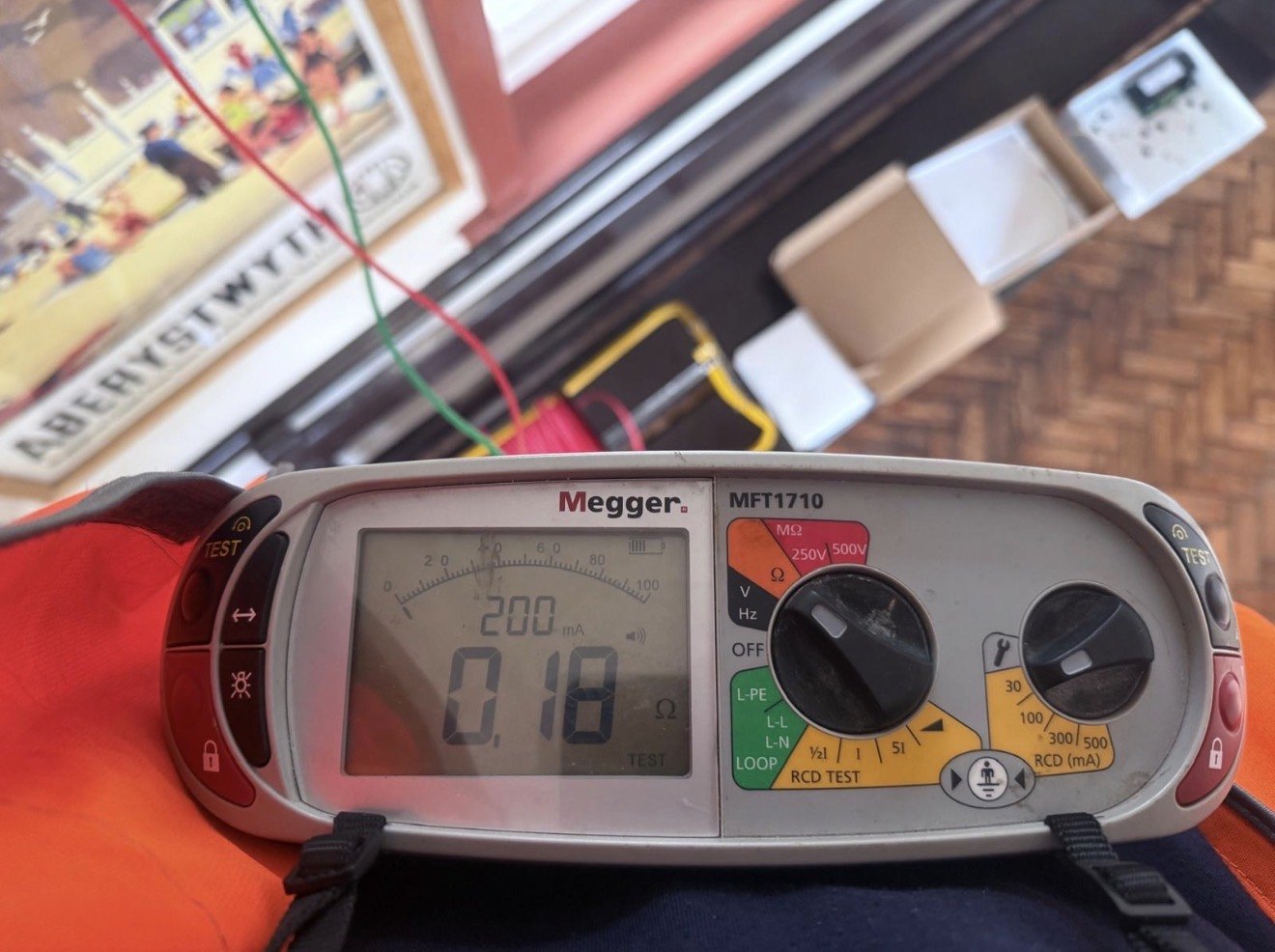
- Testing. We test continuity, insulation resistance, polarity, earth fault loop impedance and RCD operation, using calibrated test equipment. Some of these tests need circuits to be switched off.
- The report. You get an EICR with the overall result, the coded observations and the recommended date for the next inspection, and we talk you through it in plain English.
- Remedial work. If anything needs putting right, we quote for it separately, carry it out when you’re ready and certify it.
Planning fixed wire testing without stopping the business
Because some tests need circuits isolated, the main worry for most businesses is downtime. A few things help:
- Out-of-hours testing. EICRs can be arranged out of hours, such as evenings or weekends, so offices, shops and production areas keep working.
- Testing in sections. Large sites can be tested board by board, so only one area is affected at a time.
- Labelled boards and up-to-date drawings. If circuit charts are missing, part of the job is tracing circuits. Tell us at the survey and we’ll allow for it.
- Servers and critical kit. Let us know about IT rooms, freezers, lifts, medical equipment or anything that can’t lose power, and we’ll plan around them.
- One visit for more than one job. PAT testing can often be planned for around the same time, although PAT testing isn’t done out of hours. If we also look after your emergency lighting or fire alarm, we can line those visits up too.

Who should carry out your EICR?
The inspection should be done by a competent electrician who works to BS 7671 and understands commercial installations, including 3 phase supplies. Using a contractor assessed under a scheme such as NICEIC gives you independent checks on the standard of the work.
SAFE is NICEIC approved for electrical work. Ryan, our NICEIC Qualified Supervisor, is responsible for the standard of the electrical work we carry out, and every inspection is done by our own experienced engineers. We work on commercial and public buildings only: offices, factories, warehouses, shops, schools, care homes and other business premises across Birmingham and the West Midlands. Your reports and certificates are kept in your customer portal, with reminders before the next inspection is due.
Fixed wire testing checklist for businesses
- Find your last EICR and check the recommended date for the next inspection.
- Check whether it was satisfactory, and whether every C1, C2 and FI item has been put right and certified.
- Note any changes since the last test: new circuits, refits, a change of use or damage.
- Check what your insurer and your lease ask for.
- Make sure distribution boards are accessible and, ideally, labelled.
- List anything that can’t lose power, and decide whether out-of-hours testing makes sense.
- Plan PAT testing alongside it.
Book fixed wire testing with SAFE
We carry out commercial EICRs in Birmingham and across the West Midlands, alongside the rest of our electrical services and the work of our commercial electricians in Birmingham. Book your free site survey and we’ll tell you what’s involved, how long it will take and which circuits need to be off and when.
Book your free site survey or call 0333 224 0247.
Fixed wire testing: frequently asked questions
What is fixed wire testing?
Fixed wire testing is an inspection and test of the electrical installation that is fixed in place in a building: the incoming supply, distribution boards, circuits, cables, sockets, switches, light fittings and equipment wired straight in. It is carried out to BS 7671 and ends with an Electrical Installation Condition Report (EICR), so the terms fixed wire testing, periodic inspection and EICR all describe the same job.
Is an EICR a legal requirement for businesses?
There is no law that names the EICR or sets a fixed date. But the Electricity at Work Regulations 1989 require businesses to maintain their electrical systems so as to prevent danger, so far as reasonably practicable. A periodic EICR (fixed wire test) is the accepted way to show you are doing that, and insurers often ask for a current report.
How often does a business need fixed wire testing?
IET guidance recommends maximum intervals between inspections based on the type of premises, for example up to five years for offices and shops and up to three years for industrial premises. The person who carries out the inspection can recommend a shorter interval, and your last report should state when the next one is due.
How long is an EICR valid for?
An EICR doesn’t expire on a set date. It records the condition of the installation on the day it was inspected and recommends when the next inspection is due. For most offices and shops that is up to five years, and for industrial premises up to three, but it can be sooner if the inspector finds wear, damage or heavy use.
What is the difference between fixed wire testing and PAT testing?
Fixed wire testing (an EICR) covers the building’s fixed wiring: distribution boards, circuits, sockets, switches and fixed equipment. PAT testing covers portable and plug-in equipment, such as computers, kettles, power tools and 3 phase machines that plug in. Most businesses need both, and they can often be planned together.
What do C1, C2, C3 and FI mean on an EICR?
C1 means danger present, so immediate action is needed. C2 means potentially dangerous, so urgent remedial action is needed. C3 means improvement recommended. FI means further investigation is needed without delay. Any C1, C2 or FI makes the report unsatisfactory until the work is done.
Will the power be off during fixed wire testing?
Some tests need circuits to be isolated, so parts of the building will be without power for short periods. We agree the timing with you before we start, and EICRs can be arranged out of hours so your business keeps working.
Who can carry out an EICR for a business?
The inspection should be done by a competent electrician working to BS 7671. Using a contractor that is assessed by a scheme such as NICEIC gives you independent checks on the standard of the work. SAFE is NICEIC approved, and Ryan, our NICEIC Qualified Supervisor, is responsible for the standard of our electrical work.
Do I need fixed wire testing when I take on new commercial premises?
It is sensible to have one. Ask for the latest EICR when you take on a unit, and arrange a new inspection if there isn’t a current report, if it lists C1, C2 or FI items that haven’t been signed off, or if you plan a refit or change of use. Your lease may also say who is responsible for the fixed installation, so check it before you book.