By Martin Lowe, Managing Director, SAFE Fire & Security Systems Ltd, Halesowen Last updated: 25 October 2026
The short answer: In a commercial building, the fire alarm should be tested every week by someone on site, using a different manual call point each time, and the result written in the logbook. A competent fire alarm company should then inspect and service the system about every six months, and every detector and call point should be tested over the course of each year. This follows BS 5839-1, the British Standard for fire alarms in non-domestic buildings.
This guide is for business owners, facilities managers, school business managers and anyone who looks after a commercial or public building. Homes are covered by a different standard, so smoke alarms at home aren’t covered here.
Fire alarm testing at a glance
| How often | Who does it | What happens |
|---|---|---|
| Every week | You or someone you nominate | Test a different manual call point, check the sounders work, write it in the logbook |
| Every month (if needed) | You or someone you nominate | Repeat the test for staff who only work out of hours; test any standby generator |
| About every 6 months (5 to 7 months) | A competent fire alarm company | Inspection and service, logbook review, panel clock check, alarm receiving centre signals checked |
| Over each 12 months | A competent fire alarm company | Every detector and call point tested, zone plan checked against the building |
Fire alarm testing legal requirements in the UK
Under the Regulatory Reform (Fire Safety) Order 2005, the “responsible person” for a commercial building must make sure its fire safety equipment is kept in good working order. Article 17 of the Order says equipment such as the fire alarm must be covered by a suitable system of maintenance and kept in efficient working order and good repair.
The law doesn’t set the timetable. That’s where BS 5839-1 comes in. It’s the British Standard fire officers and insurers use to judge whether a fire alarm is being looked after properly, and it recommends a weekly test by someone on site and a service by a competent engineer about every six months. So the weekly test isn’t written into the law itself, but if you can’t show it’s being done, it’s hard to show you’re meeting the legal duty. Scotland and Northern Ireland have their own fire safety laws, but the same British Standard is used.
If you’re not sure whether that’s you, our guide to the responsible person and their legal duties explains it.
Regular testing is how you show you’re meeting that duty. It also means a fault is found on a quiet Tuesday morning rather than on the day there’s a fire. A fire officer or your insurer may ask to see the logbook, so the records matter as much as the test itself.
For the wider picture, including system categories and building regulations, see our guide to UK fire alarm regulations.
The weekly fire alarm test: how often and how long?
Once. BS 5839-1 recommends a weekly test of the system by the building’s management. The weekly test isn’t mandatory in the sense of a law that names it, but it is what the British Standard recommends, and it’s the easiest way to show the alarm is being kept in working order.
Good practice for the weekly test:
- Use a different manual call point each week, working round the building in turn, so every call point gets tested over time.
- Test during normal working hours, at roughly the same time each week, so people recognise it as a test.
- Let the sounders run for at least 5 seconds and normally no more than 60 seconds.
- Write the date, time, call point and result in the logbook.
If some staff only work outside normal hours, such as cleaners or a night shift, repeat the test for them at least monthly so they know what the alarm sounds like. If your system is backed up by a standby generator, that needs a monthly test too.
How to test a fire alarm, step by step
This is the weekly test most businesses carry out. Your fire alarm company should show you how it works on your own panel.
- Tell people first. Let staff and any visitors know the weekly fire alarm test is about to happen, so nobody evacuates.
- Tell your alarm receiving centre. If your fire alarm is monitored, call the receiving centre and tell them you’re testing, so they don’t call the fire service.
- Pick this week’s call point. Check the logbook to see which one is next.
- Activate the call point with the test key. Most modern call points have a small slot for a test key. Inserting the key triggers the call point without breaking anything.
- Check the alarm sounds. Make sure the sounders and beacons operate. It helps to have a colleague in another part of the building confirm they heard it.
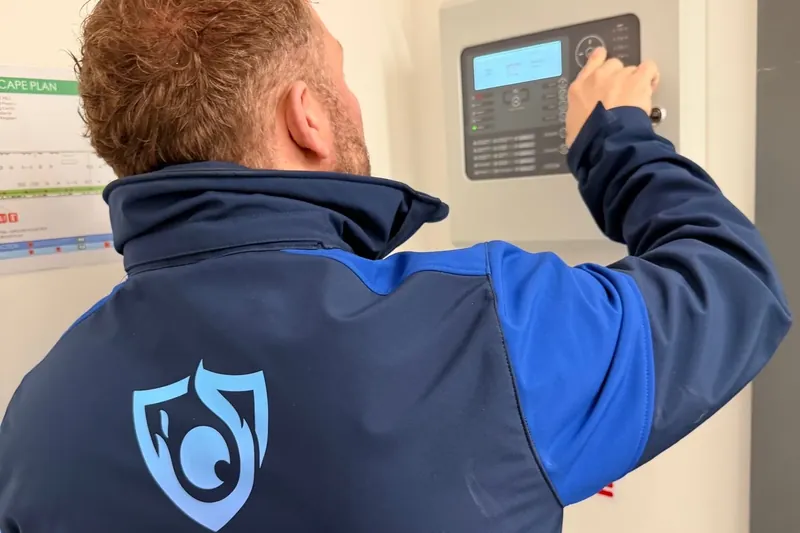
- Check the panel. The panel should show the call point or zone you activated. If it shows something else, note it and tell your fire alarm company.
- Silence and reset. Silence the sounders and reset the panel following its instructions, then reset the call point with the key.
- Tell the receiving centre you’ve finished, and check they received the signal if they can confirm it.
- Write it in the logbook, including the call point used and anything that didn’t work.
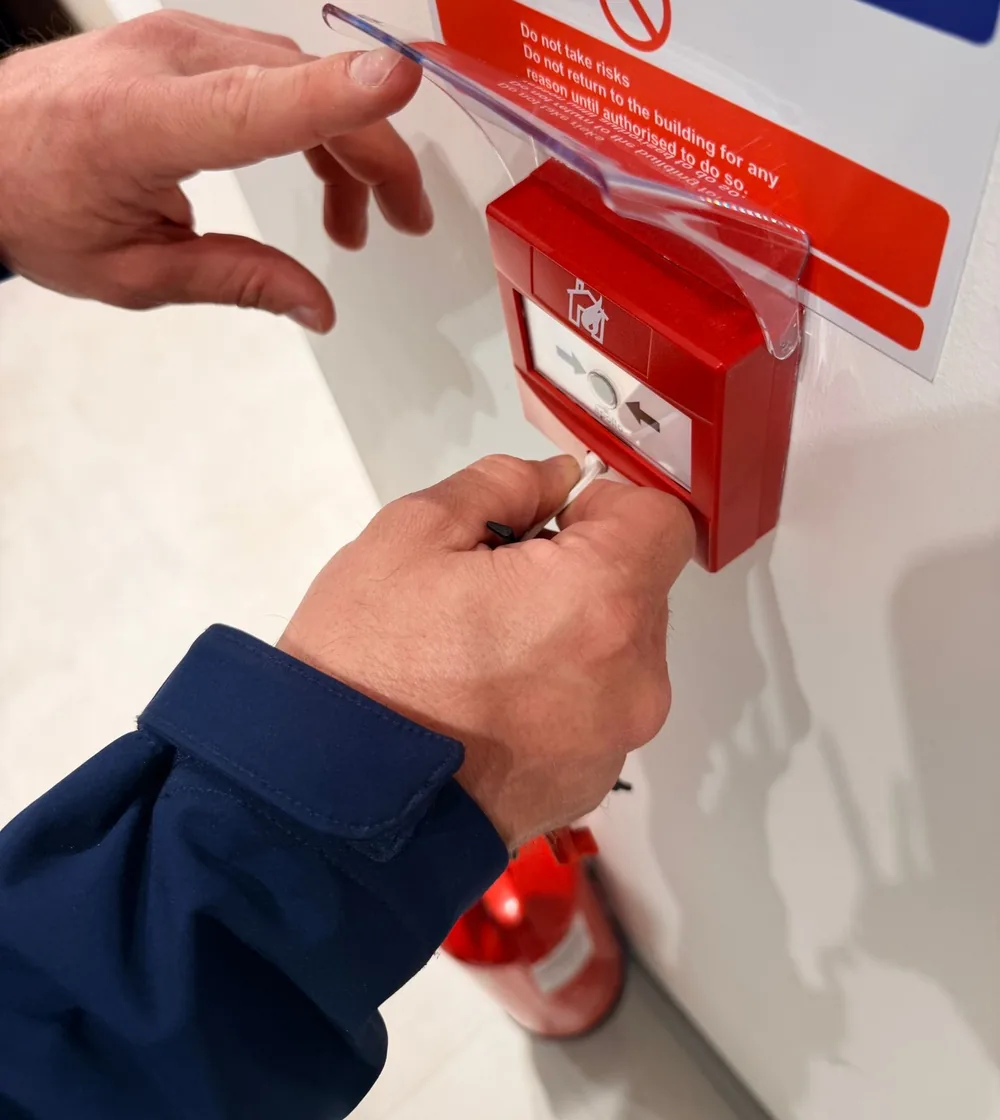
If anything doesn’t work, such as a sounder that stays quiet or a panel showing a fault, report it to your fire alarm company straight away and record it in the logbook.
How often does a fire alarm need servicing?
BS 5839-1 recommends that a competent person inspects and services the system at intervals of about six months. The 2025 edition of the standard allows some flexibility: a service any time between 5 and 7 months after the last one is acceptable, counted from the date the system was handed over.
At each visit, the engineer should check the system, review the logbook for faults and false alarms, check the panel clock, and confirm signals reach your alarm receiving centre if you have one. Over each 12 months, every detector and call point should be tested and the zone plan checked against the building.
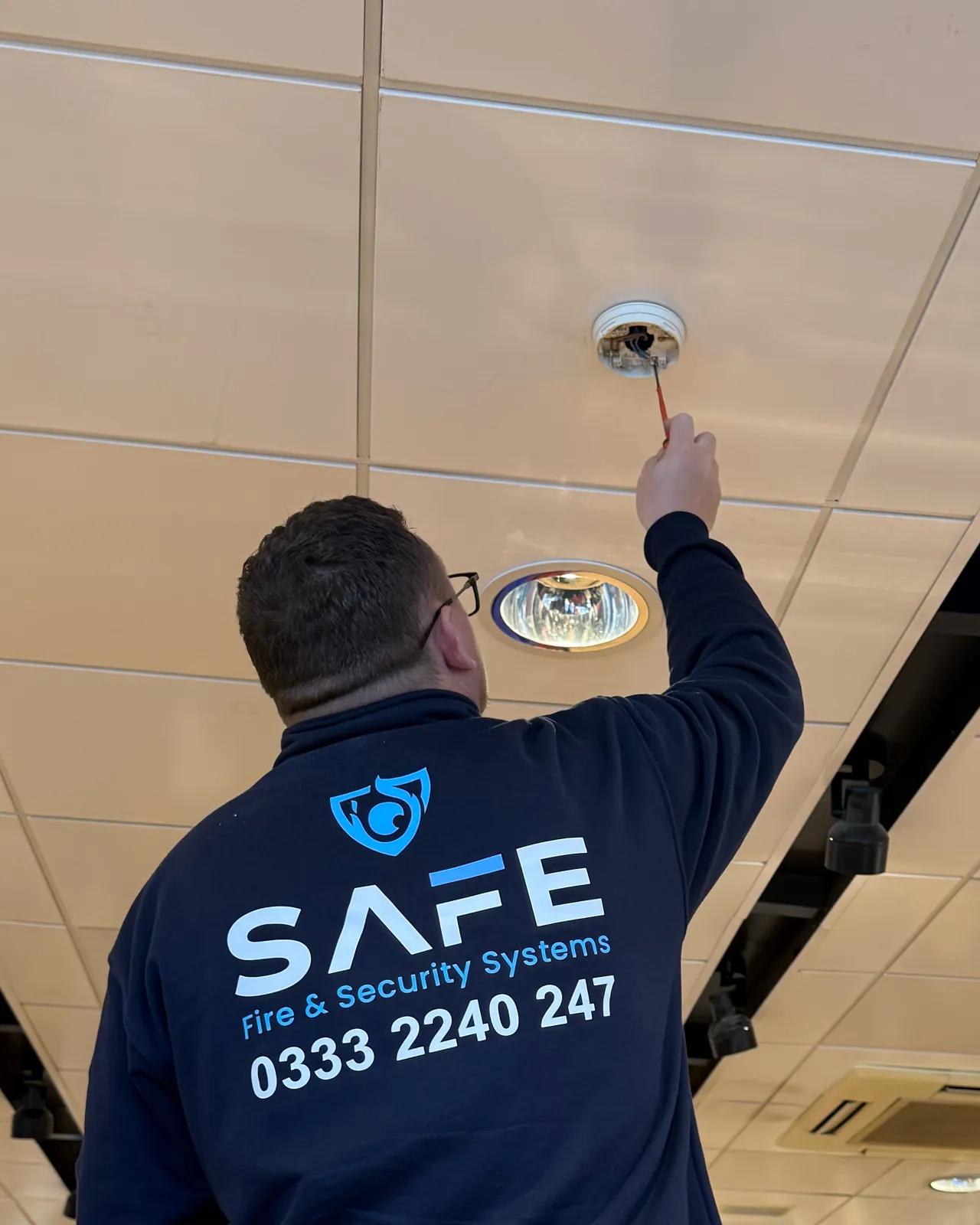
The weekly test you do doesn’t replace servicing. Pressing a call point proves the alarm sounds. It doesn’t prove every smoke detector can sense smoke, that the batteries will hold up in a power cut, or that the wiring is sound. That’s what the service visit is for.
We service commercial fire alarms across the West Midlands with our own experienced engineers. You can read more about our fire alarm servicing and maintenance.
Do fire alarms test themselves?
Not fully. A modern fire alarm panel watches its own wiring and devices and will show a fault warning if something is disconnected or failing. That’s useful, but it isn’t the same as a test. The panel can’t tell you whether people in every part of the building can hear the alarm, which is why the weekly test and the six-monthly service still matter.
What about emergency lighting?
Emergency lighting has its own testing routine under BS 5266-1: a short functional test every month and a full-duration test once a year. Many businesses do the monthly emergency lighting check on the same day as a weekly fire alarm test, so it doesn’t get forgotten. We look after emergency lighting testing and maintenance too.
Weekly fire alarm test checklist
- ☐ Staff and visitors told before the test
- ☐ Alarm receiving centre told before and after (if monitored)
- ☐ A different call point used from last week
- ☐ Sounders heard throughout the building
- ☐ Panel showed the right call point or zone
- ☐ Panel and call point reset
- ☐ Result written in the logbook
- ☐ Any fault reported to your fire alarm company
Fire alarm testing: your questions answered
How often should fire alarms be tested in the UK?
In a commercial building, BS 5839-1 recommends a weekly test using a different manual call point each time, with the result logged. A competent fire alarm company should also inspect and service the system about every six months.
How often should commercial fire alarms be tested?
Every week by someone on site, and every six months or so by a competent servicing company. Over each 12 months, every detector and call point should be tested during servicing.
How do you test a fire alarm with a key?
Insert the test key into the slot on the manual call point. This triggers the alarm without breaking the call point. Once you’ve checked the sounders and the panel, silence and reset the panel, then use the key to reset the call point.
How long should a fire alarm test last?
The sounders should run for at least 5 seconds and normally no more than 60 seconds. The whole weekly test, including telling people and filling in the logbook, usually only takes a few minutes.
Are weekly fire alarm tests mandatory?
The law requires the responsible person to keep the fire alarm in good working order. The weekly test is what BS 5839-1 recommends to do that, and it’s what a fire officer or insurer will usually expect to see in the logbook.
Who should test the fire alarm?
The weekly test can be done by the responsible person or someone they nominate, such as a fire marshal or caretaker. Servicing should be done by a competent fire alarm company. Choosing a BAFE or NSI approved company is the easiest way to know its fire alarm work is independently inspected.
Do fire alarms test themselves?
No. The panel monitors itself for faults, but it can’t check that the alarm can be heard across the building or that every detector senses smoke. You still need the weekly test and regular servicing.
Is fire alarm testing a legal requirement?
The law requires the responsible person to keep the fire alarm maintained and in good working order (Article 17 of the Fire Safety Order). It doesn’t name a weekly test, but BS 5839-1 recommends one, and a fire officer or insurer will normally expect to see weekly tests and six-monthly servicing recorded in the logbook.
How often should a fire alarm be serviced?
About every six months, by a competent fire alarm company. Under the 2025 edition of BS 5839-1, a service any time between five and seven months after the last one is acceptable. Your fire risk assessment may call for more frequent visits in higher-risk premises.
Want to know more about the standard?
Our plain-English guide to BS 5839-1 covers system categories, servicing and what changed in the 2025 edition. If your system keeps giving faults, see the top 5 signs your fire alarm system needs replacing.
Areas we cover
From our base in Halesowen, we install and service commercial fire alarms across the West Midlands, including Birmingham, Dudley, Stourbridge, Halesowen and the Black Country, Wolverhampton, Walsall, West Bromwich, Solihull, Sutton Coldfield, Bromsgrove, Kidderminster, Redditch, Hagley and Worcester.
Not sure your fire alarm is being tested properly?
Book your free site survey. It’s a short, non-invasive visit: we’ll see what’s needed, guide you to a compliant solution and give you costs. We don’t test or open up any equipment. No obligation and no hard sell.
Book your free site survey · Call 0333 224 0247 · enquiries@safefireandsecurity.co.uk