By Martin Lowe, Managing Director, SAFE Fire & Security Systems Ltd, Halesowen Last updated: 5 November 2026
The short answer: There are five main types of fire extinguisher in the UK: water (red label), foam (cream label), dry powder (blue label), CO₂ (black label) and wet chemical (yellow label). Each one is made for different classes of fire, so the right type depends on what could catch fire in each part of your building. Using the wrong one can make a fire worse.
This guide is for business owners, facilities managers, school business managers and anyone responsible for a commercial or public building. It explains the classes of fire, what each extinguisher colour means, which type goes where, and how many you’re likely to need.
Fire extinguisher types at a glance
| Type | Label colour | Use on | Don’t use on |
|---|---|---|---|
| Water | Red | Class A: wood, paper, textiles, cardboard | Electrical equipment, burning liquids, cooking oil |
| Foam (AFFF) | Cream | Class A and Class B: solids and flammable liquids such as petrol and paint | Cooking oil, and live electrical equipment unless the label says it’s been tested for it |
| Dry powder (ABC) | Blue | Class A, B and C: solids, liquids and flammable gases, plus electrical | Cooking oil; avoid in small enclosed rooms |
| CO₂ (carbon dioxide) | Black | Class B and electrical fires | Cooking oil, and not ideal for solids like paper or wood |
| Wet chemical | Yellow | Class F: cooking oils and fats, plus Class A | Electrical equipment, flammable gases |
Specialist dry powder extinguishers are also made for Class D fires involving metals. They’re only needed where metals such as magnesium or lithium are worked or stored.
Fire extinguisher classes: the classes of fire in the UK
Fires are grouped into classes by what’s burning. In the UK they follow the European standard BS EN 2:
- Class A: ordinary solid materials, such as wood, paper, cardboard, fabric and some plastics.
- Class B: flammable liquids, such as petrol, diesel, paint, solvents and spirits.
- Class C: flammable gases, such as propane, butane and natural gas.
- Class D: burning metals, such as magnesium, aluminium swarf and lithium.
- Class F: cooking oils and fats, such as a deep fat fryer in a commercial kitchen.
Electrical fires aren’t a class of their own, because electricity isn’t a fuel. Once the power is off, the fire becomes whatever class of material is burning. Until then, you need an extinguisher that’s safe to use near live equipment, which is why CO₂ is the usual choice beside computers, server racks and electrical cupboards.
Which extinguisher for which fire?
Match the extinguisher to the class of fire it may have to tackle:
- Class A (solids such as wood, paper, card and fabric): water, water mist, foam, ABC powder or wet chemical.
- Class B (flammable liquids): foam, CO₂ or ABC powder.
- Class C (flammable gases): ABC powder, and only if the gas supply can be turned off first. Otherwise leave the building and call 999.
- Class D (metals): a specialist dry powder made for the metal involved.
- Electrical equipment: CO₂, or powder where mess doesn’t matter.
- Class F (cooking oils and fats): wet chemical, with a fire blanket nearby.
So a stockroom full of paper, card or art supplies is a Class A risk, and a water or foam extinguisher is the right choice there.
Fire extinguisher colours: what each label means
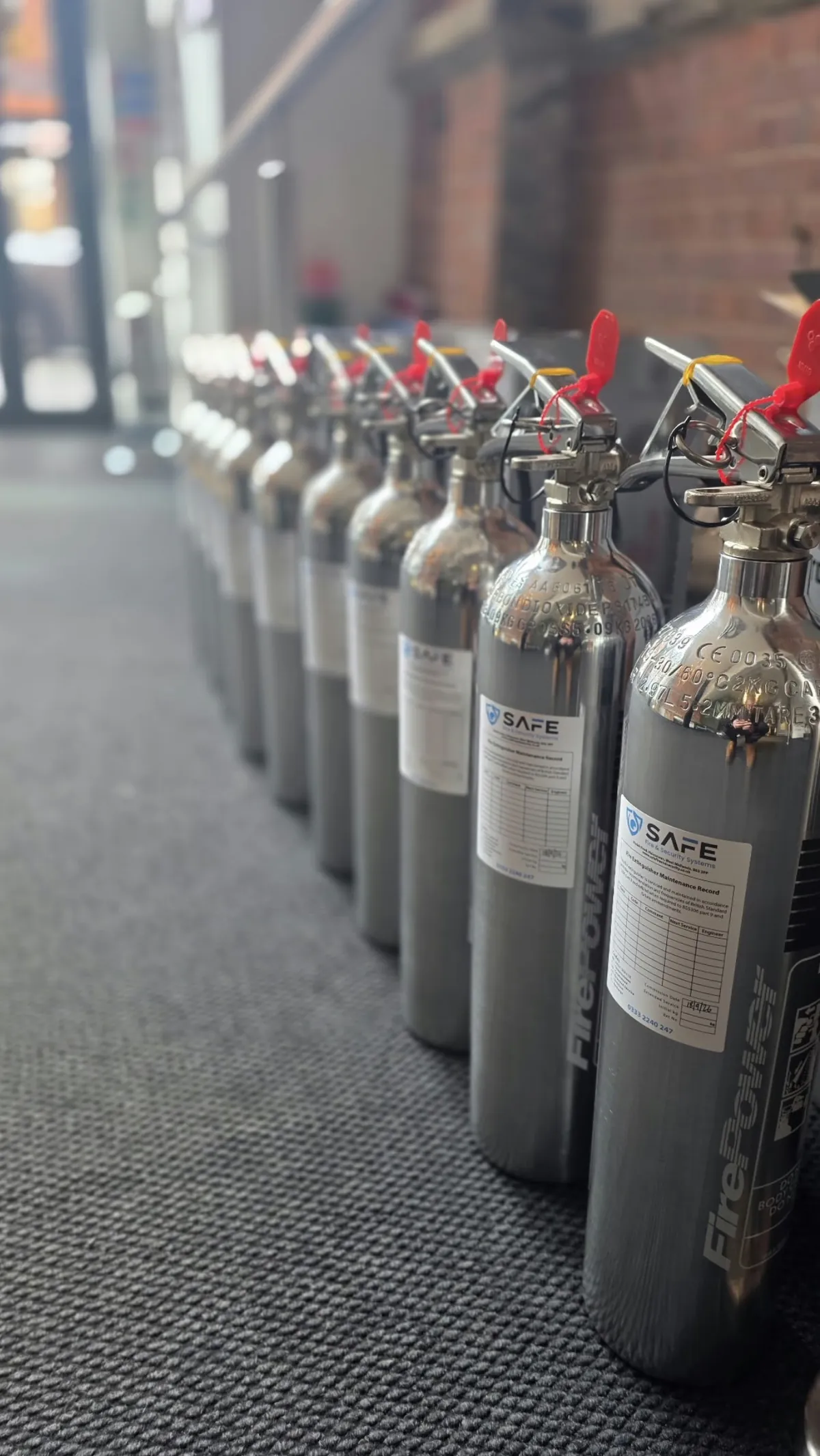
In the UK every fire extinguisher body is red. The type is shown by a coloured band or label covering a small part of the body. This has been the rule since 1997, under BS EN 3. Older extinguishers that were painted all over in one colour should have been replaced long ago, so if you still have any, it’s worth getting them checked.
Red label: water
A red extinguisher with no other colour band is water, for Class A fires such as paper, wood and textiles. Never use it on electrics or burning oil. Water mist extinguishers are usually marked with a white label.
Cream label: foam
A cream band means foam (AFFF), for Class A solids and Class B flammable liquids such as petrol and paint.
Blue label: dry powder
A blue band or panel means dry powder. Standard ABC powder covers Class A, B and C fires and electrical equipment, but it makes a mess and cuts visibility, so it’s best kept for outdoor areas, plant rooms and vehicles. Specialist Class D powders for metal fires also carry a blue label.
Black label: CO₂
A black band means carbon dioxide (CO₂), the usual choice for electrical equipment and server rooms, and also rated for Class B liquids.
Yellow label: wet chemical
A yellow band means wet chemical, made for Class F fires involving cooking oil and fats in commercial kitchens. Most wet chemical extinguishers are also rated for Class A fires.
The label also shows which classes of fire it’s rated for, using pictograms and a rating such as 13A or 55B. The higher the number, the bigger the fire it’s been tested to put out.
Each type explained
Water extinguishers (red label)
Water extinguishers cool the burning material and are the most common choice for Class A fires in offices, schools, shops and warehouses. Some water extinguishers contain additives that make them more effective, and water mist extinguishers use very fine droplets. A standard water extinguisher must never be used on electrical equipment or burning oil.
Foam extinguishers (cream label)
Foam extinguishers work on Class A fires and on Class B flammable liquids, because the foam forms a layer over the liquid and stops it re-igniting. They suit buildings with both general materials and stored liquids, such as workshops and garages. Don’t use them on cooking oil fires, and only use them near electrical equipment if the label shows they’ve been tested for it.
Dry powder extinguishers (blue label)
Standard ABC powder extinguishers cover the widest range: solids, liquids, gases and electrical fires. That makes them useful outdoors, in vehicles, plant rooms and near gas cylinders. The downside is that the powder cuts visibility, can be breathed in, and leaves a fine mess that damages equipment. For those reasons, powder isn’t usually recommended in offices or other small enclosed rooms where people work.
CO₂ extinguishers (black label)
CO₂ extinguishers smother a fire by pushing out the oxygen, and leave no residue. They’re the standard choice for electrical risks such as server rooms, offices full of computers and switch rooms, and they also work on Class B liquids. CO₂ is less effective on solids like paper and wood because it doesn’t cool them. The horn gets very cold when in use, so hold the extinguisher by the handle, not the horn.
Wet chemical extinguishers (yellow label)
Wet chemical extinguishers are made for Class F fires in commercial kitchens, where burning oils and fats reach very high temperatures. The chemical cools the oil and forms a soapy layer that seals the surface. Any kitchen with a deep fat fryer should have one nearby, usually alongside a fire blanket.
Which fire extinguisher do I need?
It depends on what could catch fire in each area. As a rough guide:
- Offices, classrooms and shops: water or foam for general materials, plus CO₂ near computers and electrical equipment.
- Stockrooms and stores of paper, card, packaging or art supplies: water or foam.
- Commercial kitchens: wet chemical near cooking equipment, plus a fire blanket, and CO₂ for electrical equipment.
- Workshops, garages and industrial units: foam for flammable liquids, CO₂ for machinery and electrics, and powder where gas cylinders are stored.
- Server rooms and electrical cupboards: CO₂.
- Outdoor areas, plant rooms and vehicles: dry powder.
Your fire risk assessment should set out what your building needs. At SAFE we partner with select, highly experienced fire risk assessors we know and trust, and our own engineers then supply and fit the extinguishers the assessment calls for.
How many fire extinguishers do I need?
There’s no single number for every business, because it depends on the size of the building, its layout and the fire risks inside. The British Standard for siting extinguishers, BS 5306-8, gives the usual starting points:
- Most floors need at least two extinguishers suitable for Class A fires, unless the floor is very small.
- Nobody should normally have to travel more than 30 metres to reach one.
- Extra extinguishers are needed for specific risks, such as a kitchen, a server room or a store of flammable liquids.
- They should be on brackets or stands, clearly signed, and placed on escape routes, near exits and close to the risk they cover.
The fire risk assessment is where the final number is set. If you’re not sure your building has the right number, a free site survey is the quickest way to find out.
How often do fire extinguishers need servicing?
Under the Regulatory Reform (Fire Safety) Order 2005, the responsible person must provide suitable firefighting equipment and keep it maintained. If you’re not sure whether that’s you, our guide to the responsible person and their legal duties explains it. The servicing standard, BS 5306-3, sets out:
- Every month: a quick visual check by someone on site. Is each extinguisher in its place, undamaged, with the pin and seal intact and the gauge (where fitted) in the green?
- Every year: a basic service by a competent engineer, who checks, weighs, tests and tags each extinguisher.
- Every 5 years: an extended service for water, foam, powder and wet chemical extinguishers, which includes a test discharge and refill.
- Every 10 years: an overhaul or replacement for CO₂ extinguishers.
Any extinguisher that has been used, even partly, should be refilled or replaced straight away.
When an extinguisher is due for its 5-year discharge test or its 10-year CO₂ overhaul, we’ll often recommend replacing it instead, if that works out more cost effective. We’ll explain both options so you can choose.
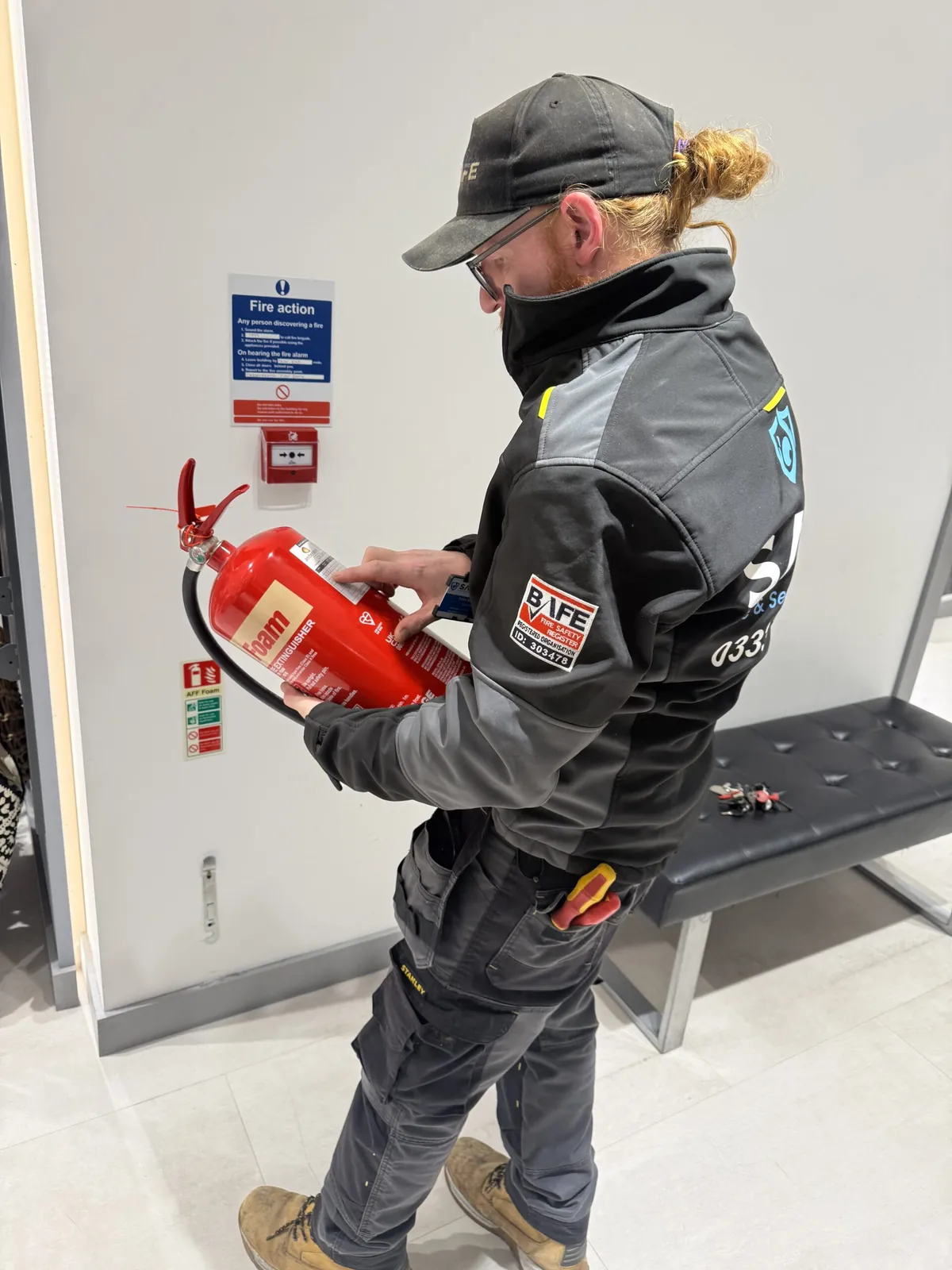
Our own engineers carry out fire extinguisher servicing for commercial buildings across the West Midlands, and every service record is kept in our online customer portal, ready for your insurer or a fire officer.
Based in Birmingham? See our page on fire extinguisher servicing in Birmingham.
Fire extinguisher questions answered
What are the 5 types of fire extinguisher?
Water (red label), foam (cream label), dry powder (blue label), CO₂ (black label) and wet chemical (yellow label). Specialist powder extinguishers for Class D metal fires also exist but are only needed in a few workplaces.
What are the classes of fire in the UK?
Class A is solid materials, Class B is flammable liquids, Class C is flammable gases, Class D is metals and Class F is cooking oils and fats. Electrical fires are treated separately because electricity isn’t a fuel.
Which fire extinguisher is used for electrical fires?
CO₂ is the usual choice for electrical fires, because it doesn’t conduct electricity and leaves no residue. Dry powder also works but makes a mess and isn’t ideal indoors. Never use a standard water extinguisher on electrical equipment.
What do the colours on fire extinguishers mean?
All UK extinguishers are red, with a coloured label or band showing what’s inside: red for water, cream for foam, blue for dry powder, black for CO₂ and yellow for wet chemical.
What is a yellow fire extinguisher used for?
A yellow label means wet chemical. It’s made for Class F fires involving cooking oils and fats, such as a deep fat fryer in a commercial kitchen, and most are also rated for Class A solids. Don’t use it on electrical equipment.
Which extinguisher should I use on which fire?
Water or foam for solids like paper and wood, foam or CO₂ for flammable liquids, CO₂ for electrical equipment, wet chemical for cooking oil, and powder for flammable gases only if the supply can be turned off. Your fire risk assessment sets what each area of your building needs.
How many fire extinguishers does my business need?
It depends on the size, layout and fire risks of your building, and your fire risk assessment should set it. As a starting point, BS 5306-8 suggests most floors need at least two extinguishers for Class A fires and nobody should have to travel more than 30 metres to reach one.
How often should fire extinguishers be serviced?
A competent engineer should service them every year, with an extended service every 5 years for most types and an overhaul or replacement every 10 years for CO₂. Someone on site should also give them a quick visual check every month. When an extinguisher is due for its discharge test or overhaul, we’ll often recommend replacing it instead if that works out more cost effective.
Do fire extinguishers expire?
They don’t have a fixed expiry date, but they do need annual servicing and the extended service or overhaul at the right intervals. An extinguisher that’s damaged, corroded, has lost pressure or has been used should be refilled or replaced.
Need the right extinguishers for your building?
We supply, install and service fire extinguishers, alongside fire alarm installation, emergency lighting and security systems, from our base in Halesowen. We’re BAFE and NSI approved, and we look after commercial buildings across Birmingham, the Black Country, Worcestershire, Warwickshire, Staffordshire and Shropshire.
Book your free site survey. We’ll see what’s needed, guide you to a compliant solution and give you costs. No obligation and no hard sell.
Book your free site survey · Call 0333 224 0247 · enquiries@safefireandsecurity.co.uk