
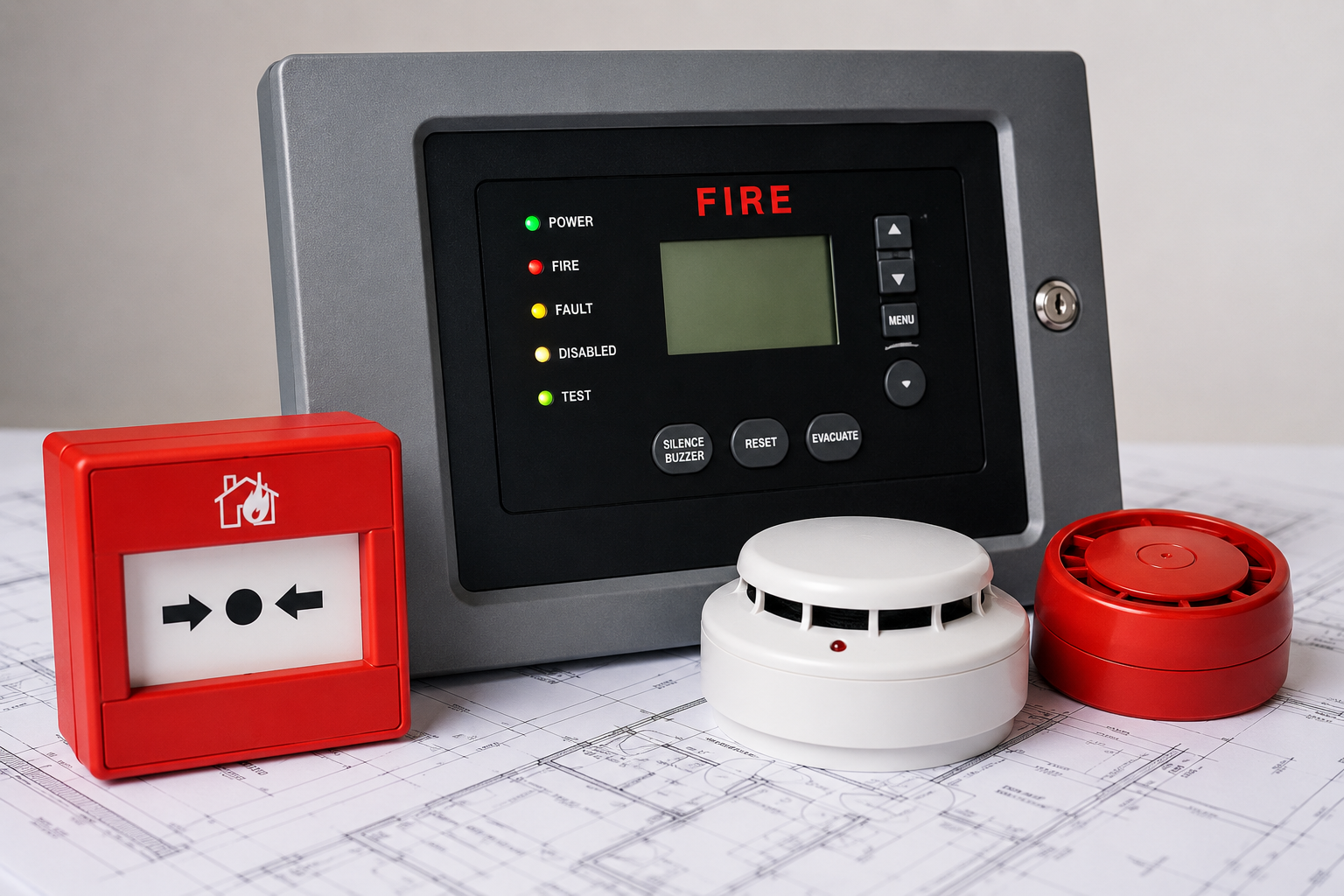
If you are a business owner or facilities manager looking into a new fire alarm system, one of the first questions you will ask is a very practical one: “How long is this actually going to take, and how much is it going to disrupt my business?”
It is a completely fair concern. You have staff to manage, customers to serve, and operations that cannot just grind to a halt for a week. The good news is that with the right planning – and the right installer – commercial fire alarm installation is far less disruptive than most people expect.
In this guide we walk you through realistic timelines, what happens at each stage, and exactly what you can do to keep your business running smoothly throughout the process.
In This Article
1. Why installation time varies so much
2. Timeline by building size
3. Phase-by-phase breakdown
4. How much disruption should you expect?
5. 6 ways to minimise business disruption
6. What happens after installation?
7. Frequently asked questions (5)
1. Why Installation Time Varies So Much
There is no single answer that applies to every building, and any installer who gives a firm quote without first visiting your site should raise a red flag. The duration depends on:
- Size and layout of the building - a 500 sq ft office is a very different job to a multi-floor warehouse
- Type of system - conventional, addressable, or wireless each have different installation demands
- Complexity of wiring routes - suspended ceilings, concrete floors, and partitioning all affect cabling time
- Number of detection zones and devices - more call points, detectors, and sounders means more time
- New build vs retrofit - retrofitting an existing building is generally more involved
- Access restrictions - working around live operations, out-of-hours requirements, or restricted areas
- Integration with other systems - linking to access control, CCTV, or sprinklers adds complexity
Quick note on regulations: All commercial fire alarm systems in the UK must comply with BS 5839-1 (the British Standard for fire detection and alarm systems in non-domestic premises). Your installer should hold BAFE SP203-1 certification – the recognised third-party standard demonstrating competence in design, installation, commissioning, and maintenance.
Link Fire Safety & Alarms - our full service -> ->
2. Timeline by Building Size
Below is a realistic guide based on building size, assuming a standard addressable system installed by a competent, accredited team.
| Building Type / Size | Typical Install Time | Disruption Level |
|---|---|---|
| Small office / retail unit Up to 200 sq m, single floor | 1/2 - 1 day | Low |
| Medium office / clinic 200-600 sq m, 1-2 floors | 1 - 2 days | Low - Medium |
| Multi-floor office building 3-5 floors, 600-2,000 sq m | 3 - 5 days | Medium |
| Large warehouse / industrial 2,000 sq m+ | 5 - 10 days | Medium |
| Hotel / care home / school Complex multi-zone premises | 1 - 3 weeks | Staged approach |
| Large complex / multi-site Bespoke phased works | Survey required | Phased plan essential |
“Most of our customers are genuinely surprised at how quickly it is done. A well-prepared two-person team can survey, cable, fit, and commission a medium-sized office in a single working day.”
– Safe Fire & Security Installation Engineer
3. Phase-by-Phase Breakdown: What Actually Happen
Understanding the process from start to finish helps you plan around it. Here is what a typical commercial fire alarm installation looks like.
1
Site Survey & System Design
Time: 1-3 hours (typically free of charge)
Before anything is quoted or ordered, an engineer visits your premises to assess the building layout, occupancy type, existing infrastructure, and specific risks. This is where BS 5839-1 categories are determined. The survey shapes the entire design – detector positions, cable routes, control panel location, and zone mapping. A thorough survey means fewer surprises on installation day.
2
Quotation & Sign-Off
Time: 1-5 days after survey
You will receive a detailed, itemised quote covering equipment, labour, and any associated works. Once you are happy and sign off, equipment is ordered and an installation date is scheduled. If your building requires a fire risk assessment, this may be a prerequisite before work begins.
3
First Fix - Cable Installation
Time: Typically 50-60% of total installation time
This is the most physically involved stage. Engineers run fire-resistant cables through the building to each detector, call point, sounder, and the main control panel. In buildings with suspended ceilings, this is relatively unobtrusive. Most businesses can continue operating during first fix, particularly if it is done floor by floor or zone by zone.
4
Second Fix - Device Installation
Time: Typically 30% of total installation time
All individual devices are fitted: smoke detectors, heat detectors, manual call points (break glass units), sounders, visual alarm devices (VADs), and the control panel itself. For addressable systems, each device is programmed with a unique address so the panel can pinpoint exactly where an alarm triggered.
5
Commissioning & Testing
Time: 2-6 hours depending on system size
Every single device is tested and verified against the system design. The control panel is programmed, zone maps confirmed, and all sounders triggered to verify coverage. This is a critical compliance step – without it your system is not considered operational. The alarm will sound during testing: brief your team in advance.
6
Handover, Documentation & Certification
Time: 1-2 hours
You receive full as-installed drawings, commissioning certificates, operation manuals, and the BS 5839-1 commissioning report. Staff are walked through daily testing procedures – weekly manual call point tests are a legal requirement under the Regulatory Reform (Fire Safety) Order 2005.
Link Emergency Lighting - install alongside your fire alarm -> ->
4. How Much Business Disruption Should You Actually Expect?
The realistic answer for most businesses is: less than you would think, but not zero.
What you will notice:
- Engineers moving through the building running cables - this is the most visible part
- Some drilling or surface trunking work, particularly around door frames and ceiling voids
- The alarm triggered (with warning) during commissioning testing - typically 20-30 minutes in short bursts
- Brief access restrictions to certain areas while devices are being fitted
What will not be affected:
- Your ability to trade and operate throughout the vast majority of the process
- Power to your premises (fire alarm cabling runs on its own separate circuit)
- Your IT infrastructure, broadband, or phone systems
- The comfort or safety of your customers during the process
Out-of-hours installation: If your business cannot accommodate engineers during trading hours, out-of-hours and weekend installation is available. Discuss this at survey stage as it may affect the overall timeline slightly.
5. 6 Ways to Minimise Business Disruption
- Brief your team in advance - let staff know the dates, what to expect, and that the alarm will sound during testing
- Clear cable routes where possible - tidy storage rooms, shift furniture away from walls, unlock areas engineers need
- Schedule testing for quieter periods - if you have a preferred time for commissioning, let your installer know
- Ask about zone-by-zone installation - for larger buildings, work can be sequenced so only one area is affected at a time
- Inform your insurance provider - some policies require notification when fire protection systems are temporarily offline during upgrades
- Arrange temporary cover if needed - for regulated premises like care homes or HMOs, you may need interim fire precautions
Link Fire Door Services for commercial & HMO premises -> ->
6. What Happens After the Installation Is Complete?
Installation is only part of the story. A commercial fire alarm system requires regular, documented maintenance to remain compliant with BS 5839-1 and the Regulatory Reform (Fire Safety) Order 2005.
Ongoing maintenance requirements:
- Weekly testing - a manual call point should be tested every week and logged in your fire alarm logbook
- Six-monthly servicing - a full service visit by a competent engineer is required twice a year
- Annual inspection - comprehensive inspection covering all devices, cabling, control panel, and batteries
- Logbook maintenance - all faults, tests, activations, and service visits must be recorded
Link Why choose Safe Fire & Security? -> ->
BAFE SP203-1 . NSI Silver . SafeContractor approved
Ready to Get a Free Site Survey?
Our BAFE-accredited engineers will visit your premises, assess your needs, and provide a detailed quote – with no obligation and no hard sell. Most surveys take under an hour.
Or call us free: 0333 224 0247
Frequently Asked Questions
How long does it take to install a fire alarm in a small office?
For a small office up to around 200 square metres on a single floor, a professional installation team can typically complete the full job – from first fix cabling through to commissioning and handover – in half a day to one full working day. The exact time depends on ceiling type, number of devices required, and whether any existing infrastructure is being reused. You will have a fully commissioned, certified system by the end of that day.
Can my business stay open during fire alarm installation?
In the vast majority of cases, yes. Most commercial fire alarm installations are carried out with the business fully operational. The main activities – running cables, fitting devices – do not prevent staff or customers from using the premises normally. The one exception is commissioning testing, when the alarm will sound in short bursts with advance warning. If your business is sensitive to alarm activity, out-of-hours installation can usually be arranged.
Do I need a fire risk assessment before the alarm is installed?
A fire risk assessment is a legal requirement for all non-domestic premises under the Regulatory Reform (Fire Safety) Order 2005, and it should ideally be in place before or alongside your installation. The assessment helps determine the appropriate category of system you need. A good installer will discuss this during the site survey and can recommend a suitable fire risk assessor if you do not already have one.
What is the difference between a conventional and an addressable fire alarm system?
A conventional system divides your building into broad zones – when a detector activates, the panel tells you which zone, but not the exact device. An addressable system gives every single device a unique identity, so you can identify exactly which detector or call point has activated – down to a specific room. Addressable systems are standard for larger commercial buildings, and the cost difference is far less significant than it used to be.
How often does a commercial fire alarm system need to be serviced?
Under BS 5839-1, a commercial fire alarm system should be serviced by a competent engineer at least twice a year (every six months). In addition, the responsible person must test a manual call point weekly and record it in the logbook. Annual inspections should cover all devices, cabling, batteries, and the control panel. Operating without regular servicing puts you at legal risk and significantly increases the chance of the system failing when it is needed most.
- commercial fire alarm installation
- fire alarm installation time
- fire alarm system UK
- BS 5839-1
- BAFE certified installer
- addressable fire alarm
- fire alarm business disruption
- fire safety compliance UK
- fire alarm commissioning
- commercial fire safety
- fire alarm maintenance contract
- Regulatory Reform Fire Safety Order
- fire alarm installation West Midlands
- fire alarm installation cost
- fire detection system
- NSI approved fire alarm
Leave a comment