If you’re choosing a company to design, install or maintain a fire alarm, you’ll soon see the letters BAFE and NSI. Insurers ask about them, tenders ask for them, and fire officers look for them. But what does BAFE accreditation actually mean, and how do you check that a company really has it?
Here’s a plain-English guide from SAFE Fire & Security Systems, a BAFE registered and NSI approved fire and security company based in Halesowen, working with commercial buildings across the West Midlands.
What is BAFE?
BAFE is an independent, not-for-profit body that runs the BAFE Fire Safety Register. It sets competency schemes for companies that provide fire safety services, so you can tell a properly checked provider from one that just says it is.
BAFE doesn’t audit companies itself. Each registered company is assessed by a UKAS accredited certification body, such as NSI, against the BAFE scheme it holds. The company has to keep passing those audits to stay on the register.
People often search for “BAFE accreditation”, but the correct wording is BAFE registered or BAFE certificated. The idea is the same: an independent body has checked the company against a published standard, and keeps checking.
The BAFE schemes, and which one matters for fire alarms
BAFE runs several schemes, each covering a different type of work. For example, there’s a scheme for fire detection and alarm systems, one for portable fire extinguishers (SP101) and one for fire risk assessment (SP205). A company is only registered for the schemes, and the parts of a scheme, it has actually been assessed for.
For fire alarms, the scheme is BAFE SP203-1: the competency scheme for fire detection and alarm systems. It’s split into modules:
- Design of the system, to BS 5839-1 for commercial buildings.
- Installation of the wiring and devices.
- Commissioning and handover, so the system works as designed and you get the right paperwork.
- Maintenance, the regular servicing that keeps the system reliable.
Some companies only hold one or two modules. Always check which ones a company holds before you hire it for that part of the job.
What we hold: BAFE SP203-1 and NSI approval
We’re registered under BAFE SP203-1 for the design, installation, commissioning and maintenance of fire detection and alarm systems, so all four modules. Our details are:
- BAFE Registered Organisation ID: 303478
- Certification body: NSI
We’re also NSI approved for the design, installation and maintenance of intruder and hold-up alarm systems, CCTV and access control systems. You can view both certificates on our About us page.
That means your fire alarm, intruder alarm, CCTV and access control work can all be handled by one independently checked team: our own experienced engineers, trained in our own training suite in Halesowen.
What does NSI approval mean?
The National Security Inspectorate (NSI) is a UKAS accredited certification body for the fire and security industry. It inspects companies against the British Standards and codes of practice for their work, and it checks how the business is run, not just the finished job.
NSI approval matters most for security systems. If you want police response on a monitored intruder alarm, the system generally needs to be fitted and maintained by a company certified by a UKAS accredited body such as NSI.
NSI has two levels of approval for system installers, Silver and Gold. Both cover technical competence. Gold also requires the company to hold ISO 9001 quality management certification. Ask any company which level it holds, and for which types of system.
Why third-party certification matters to you
Under the Regulatory Reform (Fire Safety) Order 2005, the responsible person for a building must make sure fire safety systems are installed and maintained by someone competent. The law doesn’t say how you prove that. Third-party certification is one of the simplest ways.
- Proof of competence. An independent body has checked the company’s work and the way it’s run. If something goes wrong, you can show you chose a certificated provider.
- Insurers. Many insurers ask whether your fire alarm was designed, installed and maintained by a certificated company. Some make it a condition of cover, so check your policy.
- Tenders and approved contractor lists. Public sector buyers and main contractors often ask for BAFE and NSI before work can start.
- Fewer surprises. Systems designed and fitted to BS 5839-1 by a checked company are more likely to pass inspection, work when needed and cause fewer false alarms.
- Fire officers. During an audit, the right certificates and records show you’re taking your duties seriously.
How to check a provider’s BAFE or NSI certification
It takes a few minutes, and it’s worth doing before you sign anything.
- Ask for the certificates. A certificated company will happily send them. Check the company name and address match the business you’re dealing with.
- Check the scope. For BAFE SP203-1, look at which modules are covered: design, installation, commissioning and maintenance. For NSI, check which types of system are listed.
- Check the dates. Certificates have an expiry date. Make sure it’s current.
- Search the registers. Use the BAFE Fire Safety Register on the BAFE website (bafe.org.uk) to search by company name or registration ID. NSI has a search for approved companies on its website (nsi.org.uk).
- Ask for the paperwork at handover. After design, installation or commissioning, you should get the right BS 5839-1 certificates for the work done. Keep them with your fire log book.
You’re welcome to check our BAFE Registered Organisation ID, 303478, on the BAFE register.
Do you need a BAFE registered company for emergency lighting and extinguishers?
The SP203-1 scheme covers fire detection and alarm systems. Emergency lighting and fire extinguishers are covered by different standards.
- Emergency lighting is electrical work, tested to BS 5266-1. We install, test and maintain self-contained emergency lighting, and our electrical work is NICEIC approved. See our emergency lighting installation and testing page.
- Fire extinguishers should be serviced every year to BS 5306-3. See our fire extinguisher servicing page.
Whoever does the work, ask how they’re qualified and checked for that type of system, and ask for the certificates.
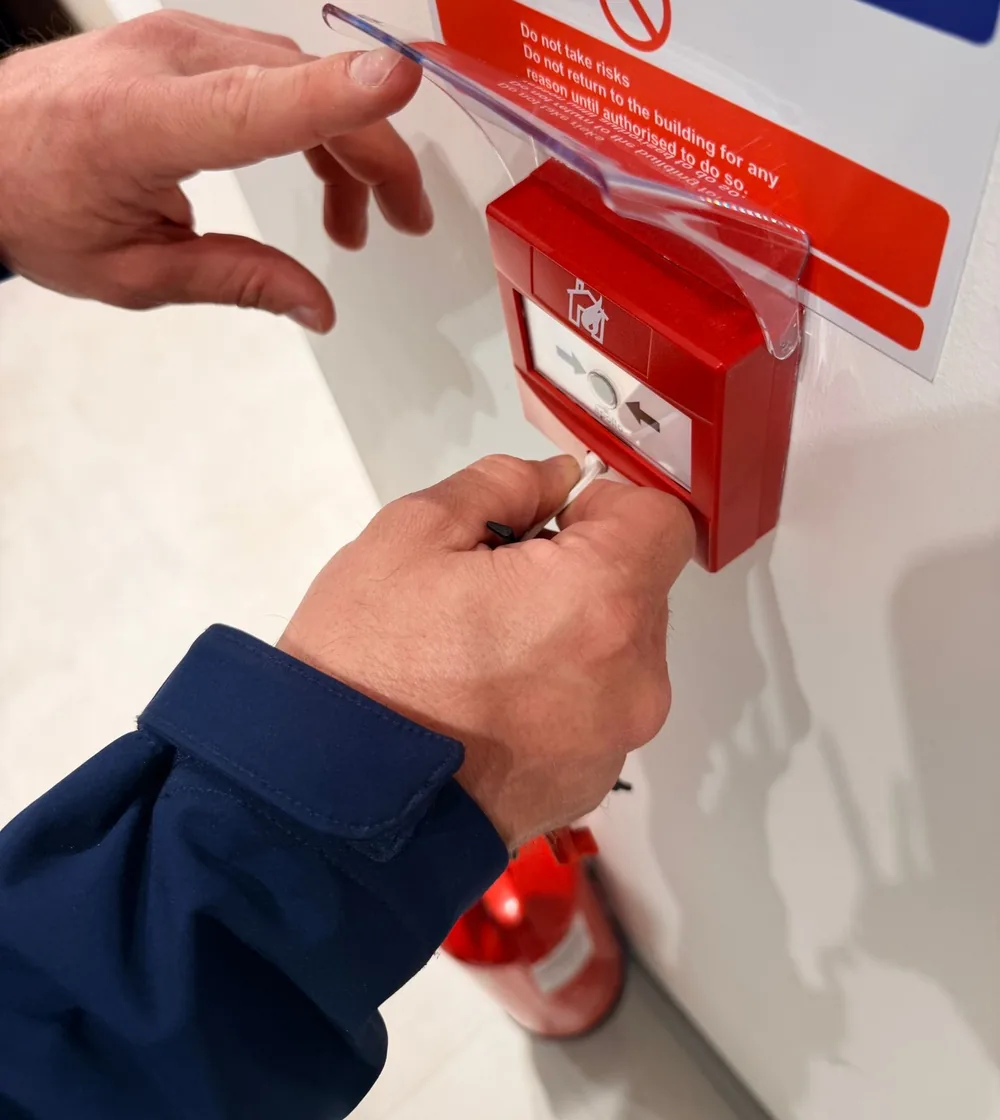
BAFE registered fire alarm installation and maintenance in the West Midlands
We design, install, commission and maintain fire alarm systems for commercial buildings across the West Midlands, including offices, industrial units, schools, care homes and leisure centres. We work on both open protocol and closed protocol systems.
- Fire alarm installation in the West Midlands, designed to BS 5839-1.
- Our BS 5839-1 guide for commercial buildings explains system categories and what the standard expects.
- How often should fire alarms be tested? covers weekly tests and six-monthly servicing.
- We also look after commercial fire alarm systems fitted by other companies.
Want a BAFE registered and NSI approved team to look at your building? Call us on 0333 224 0247 or contact us to book a free site survey.
FAQs
What is BAFE accreditation?
BAFE accreditation usually means a company is on the BAFE Fire Safety Register for one or more BAFE schemes. A UKAS accredited certification body, such as NSI, has audited the company against that scheme, and keeps auditing it to keep the registration.
Is BAFE certification a legal requirement?
No. The law says fire safety systems must be installed and maintained by a competent person. BAFE registration is a recognised way of showing that competence, and many insurers, tenders and approved contractor lists ask for it.
What is BAFE SP203-1?
SP203-1 is BAFE’s competency scheme for fire detection and alarm systems. It has modules for design, installation, commissioning and handover, and maintenance. We’re registered for all four.
How do I check if a company is BAFE registered?
Ask for their certificate, check the scope and expiry date, then search the BAFE Fire Safety Register at bafe.org.uk by company name or registration ID. Our BAFE Registered Organisation ID is 303478.
What is the difference between NSI Silver and NSI Gold?
Both are NSI approvals for system installers and both cover technical competence. NSI Gold also requires ISO 9001 quality management certification.
Can a company without BAFE registration install a fire alarm?
Yes, it isn’t illegal. But without third-party certification, nobody independent has checked their work. That can make it harder to show your insurer or a fire officer that you chose a competent provider.
Does BAFE registration cover emergency lighting?
Our BAFE SP203-1 registration covers fire detection and alarm systems. Emergency lighting is electrical work, tested to BS 5266-1. We install and test self-contained emergency lighting, and our electrical work is NICEIC approved.