
Are mobility scooters a fire risk in your building?

  • Home
  • Are mobility scooters a fire risk in your building?
Pagetitleicon
Image
By Martin Lowe, Managing Director, SAFE Fire & Security Systems Ltd, HalesowenLast updated:
The short answer:

They can be, but the risk can be managed. Mobility scooter batteries can fail if they are damaged, charged incorrectly or kept in the wrong place, and West Midlands Fire Service (WMFS) is asking every Responsible Person to make sure their fire risk assessment covers them. Sensible storage, supervised charging, clear escape routes and the right detection let residents keep their independence while everyone stays safe.

SAFE Fire & Security Systems Ltd is a Halesowen-based fire and security company, BAFE and NSI approved and an NICEIC approved contractor, working across the West Midlands.

Why is West Midlands Fire Service raising this now?

On 17 October 2026, WMFS reminded Responsible Persons (RPs) that the risk from battery-powered transport devices must be addressed in their fire risk assessment. That applies to anyone who manages fire safety in a non-domestic building or the common areas of residential buildings, such as care homes, sheltered housing, blocks of flats and HMOs.

WMFS is clear that mobility scooters help many people stay independent. Its concern is batteries that are damaged, charged incorrectly or stored somewhere unsuitable. It says most scooters are now powered by lithium-ion batteries, which can fail suddenly and cause fast-developing fires. Older scooters often use sealed lead-acid batteries, which still need safe charging.

WMFS guidance for landlords and Responsible Persons is on its e-scooters and similar devices page, with more advice on its rechargeable lithium-ion batteries page.

What do the statistics say?

There is no national count of mobility scooter fires in the UK, so we have used the closest reliable figures and labelled them clearly.

  • Mobility scooters (limited data): in 2025, fire and rescue services notified the Office for Product Safety and Standards (OPSS) of 3 fires involving a mobility scooter. Reporting is voluntary, so OPSS says the data cannot be used to estimate national numbers.
  • Lithium-ion fires in the West Midlands: WMFS attended 40 incidents involving lithium-ion batteries in 2023 and 69 in 2024. By 31 October 2025 there had already been 65.
  • E-bikes and e-scooters in London: London Fire Brigade attended a record 206 e-bike and e-scooter fires in 2025, around 17 a month. Two people died.
  • Where fires start: of 267 e-bike and e-scooter fires notified to OPSS in 2025, 23 started in a corridor or hallway, the very routes people need to escape.
  • How fast it happens: research quoted in National Fire Chiefs Council (NFCC) guidance found a burning mobility scooter reached 375°C within three minutes of ignition.

What does the law say?

The Regulatory Reform (Fire Safety) Order 2005 is the law. It requires the Responsible Person to have a suitable and sufficient fire risk assessment and to keep escape routes clear. Not sure if that is you? Read our guide to the Responsible Person and their legal duties.

Guidance such as the NFCC Mobility Scooter Guidance for Residential Buildings, the government's fire safety guidance for businesses and British Standards such as BS 5839-1 are codes of practice. They are not law, but they are how assessors and fire services judge whether you have done enough.

What should a Responsible Person check?

This checklist follows the six points in the WMFS post, with practical steps from WMFS and NFCC guidance.

What to check What good looks like
Where scooters are stored Never in corridors, stairways, lobbies or by exit doors. Use a dedicated store, ideally outside or in a room separated from the rest of the building.
Charging rooms NFCC guidance recommends storage areas inside a building have at least 30 minutes' fire-resisting construction, with self-closing fire doors and early warning of fire.
When charging happens Avoid charging overnight or while nobody is around. NFCC suggests restricting charging between 8pm and 8am, for example with timers.
Chargers Only the charger supplied by the manufacturer, or an approved replacement. Charge on a hard surface away from anything that could burn.
Battery condition Look for swelling, leaking, heat, hissing, a burning smell or a damaged case. Stop using a battery that shows any of these.
Sockets and circuits Sockets and circuits suitable for the load, with no daisy-chained extension leads. Charging equipment should be covered by electrical testing.
Detection and protection Detection suitable for the space, linked to the building's fire alarm or monitored if the building is not staffed.
Signage and resident information Clear signs in the store, and simple written advice for residents on safe use, storage and charging.
Your fire risk assessment Mobility scooters, e-bikes and e-scooters named in the assessment, with control measures and a review date.
Clear, uncluttered corridor leading to an exit door
Keep corridors, stairways and lobbies clear: they are your escape routes.

What fire detection suits a scooter store or charging room?

That depends on the room, so we will advise on the right detection for the space. A fire alarm designed, installed and maintained to BS 5839-1 is your main protection, and the store should be linked to it so everyone gets an early warning.
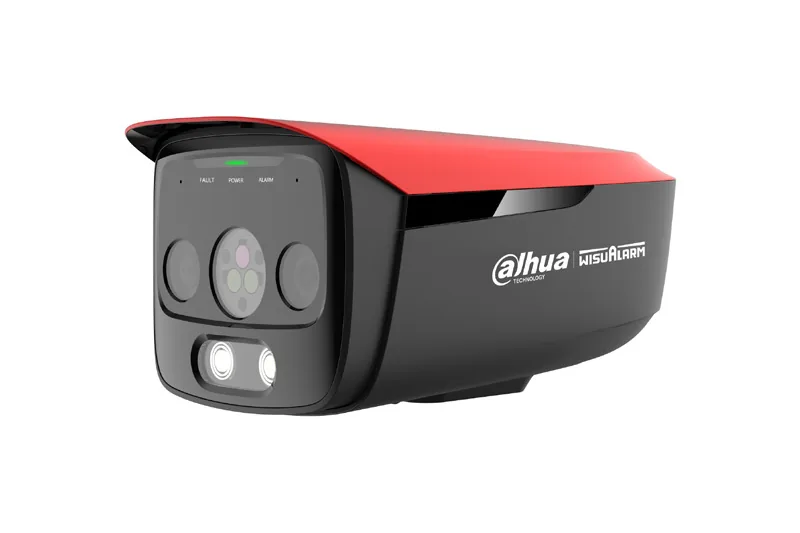
Dahua WisuAlarm DHI-HY-FT443HFP flame detection camera with thermal imaging
Dahua WisuAlarm DHI-HY-FT443HFP flame detection camera. Image: Dahua Technology product datasheet.

Thermal imaging cameras can add an extra early-warning layer. They measure temperatures across the scene and raise an alarm when a set threshold is exceeded, so a battery getting unusually hot can be flagged before a fire develops. We install Hikvision and Dahua thermal cameras:

  • Hikvision HeatPro bi-spectrum cameras, such as the DS-2TD2628T, combine thermal and normal video with a "temperature exception alarm for fire prevention" and fire and smoke detection.
  • Dahua's DHI-HY-FT443HFP flame detection camera, sold under its WisuAlarm fire brand, combines thermal imaging with flame detection that is EN 54-10 certified.

We can also wire the camera's alarm output into an input on your fire alarm panel as its own zone, labelled for example "Battery charging area". If the camera detects a problem, the fire alarm activates and shows that zone, so staff know exactly where to go. Where the fire alarm is monitored, the signal can also be passed to an alarm receiving centre or sent to a keyholder. Any connection to the fire alarm is designed and commissioned to suit your system.
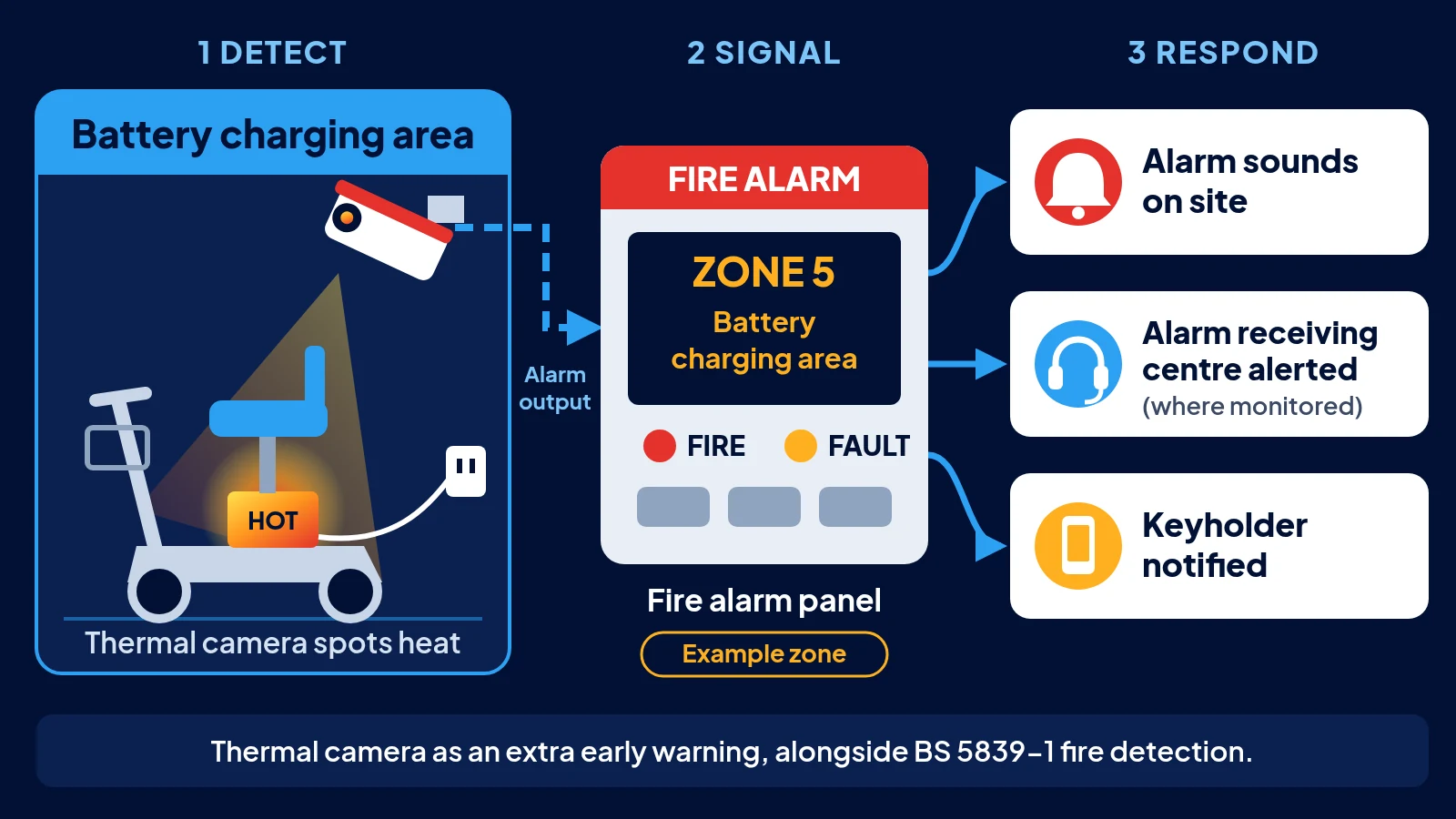
Diagram: a thermal camera in a battery charging area detects heat from a charging mobility scooter and sends its alarm output to the fire alarm panel, which shows example Zone 5: Battery charging area. The alarm then sounds on site, an alarm receiving centre is alerted where the system is monitored, and the keyholder is notified.
Example set-up. Zone numbers and connections are designed and commissioned to suit each system.

The Dahua camera is also a good fit for e-bike and e-scooter charging and storage areas, where theft can be as much of a worry as fire. As well as flame and heat detection, it gives a normal 5MP CCTV picture that can be recorded, tripwire and intrusion alerts, and a built-in microphone and speaker for two-way talk through the app or monitoring platform. So one camera can help you keep an eye on both risks.
Video thumbnail: Top Features of the NEW Dahua-Wisualarm EN54 Flame Detection Camera, showing the DHI-HY-FT443HFP camera. Play video on YouTube.
Watch on YouTube: “Top Features of the NEW Dahua-Wisualarm EN54 Flame Detection Camera” from Mast Digital (opens in a new tab).

A thermal camera is an extra early-warning layer that works alongside BS 5839-1 detection, never instead of it.

Can a lithium-ion battery extinguisher help?

Specialist lithium-ion battery extinguishers do exist. The most common type uses AVD (aqueous vermiculite dispersion), a water-based agent containing a natural mineral.
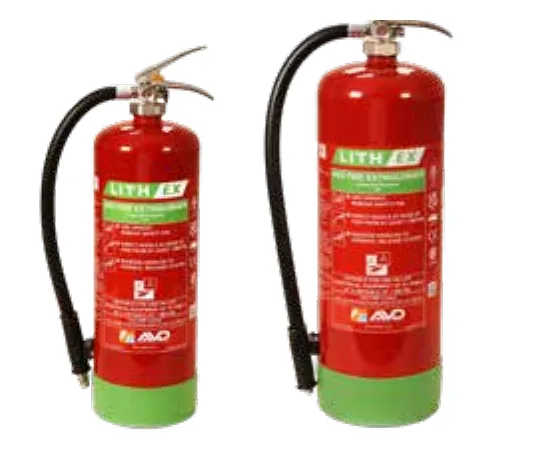
Red AVD lithium-ion battery fire extinguishers, 6 and 9 litre
AVD lithium-ion battery extinguishers, 6 and 9 litre. Image: AVD Fire.

One UK manufacturer says its 6 and 9 litre AVD extinguishers carry NTA 8133 approval, a Dutch technical assessment for portable extinguishers on lithium-ion battery fires. It says its 6 litre unit "met the NTA test requirements to extinguish, prevent re-ignition and suppress propagation to the other batteries", and says it is suitable for lithium-ion battery fires up to 600 Wh.

They are for very small fires at the earliest stage only. Your priority is always to get out, close the door behind you and call 999. Never try to tackle a battery that is hissing, venting smoke or in thermal runaway.

If your fire risk assessment calls for one:

  • site it near the charging or storage area, by the exit route, not inside the room
  • make sure staff know where it is and that escaping comes first
  • have it serviced by a competent person in line with BS 5306-3 and the manufacturer's instructions.

SAFE supplies and services AVD-type lithium-ion battery extinguishers and can advise on the right type and size for your space.

How can SAFE help?
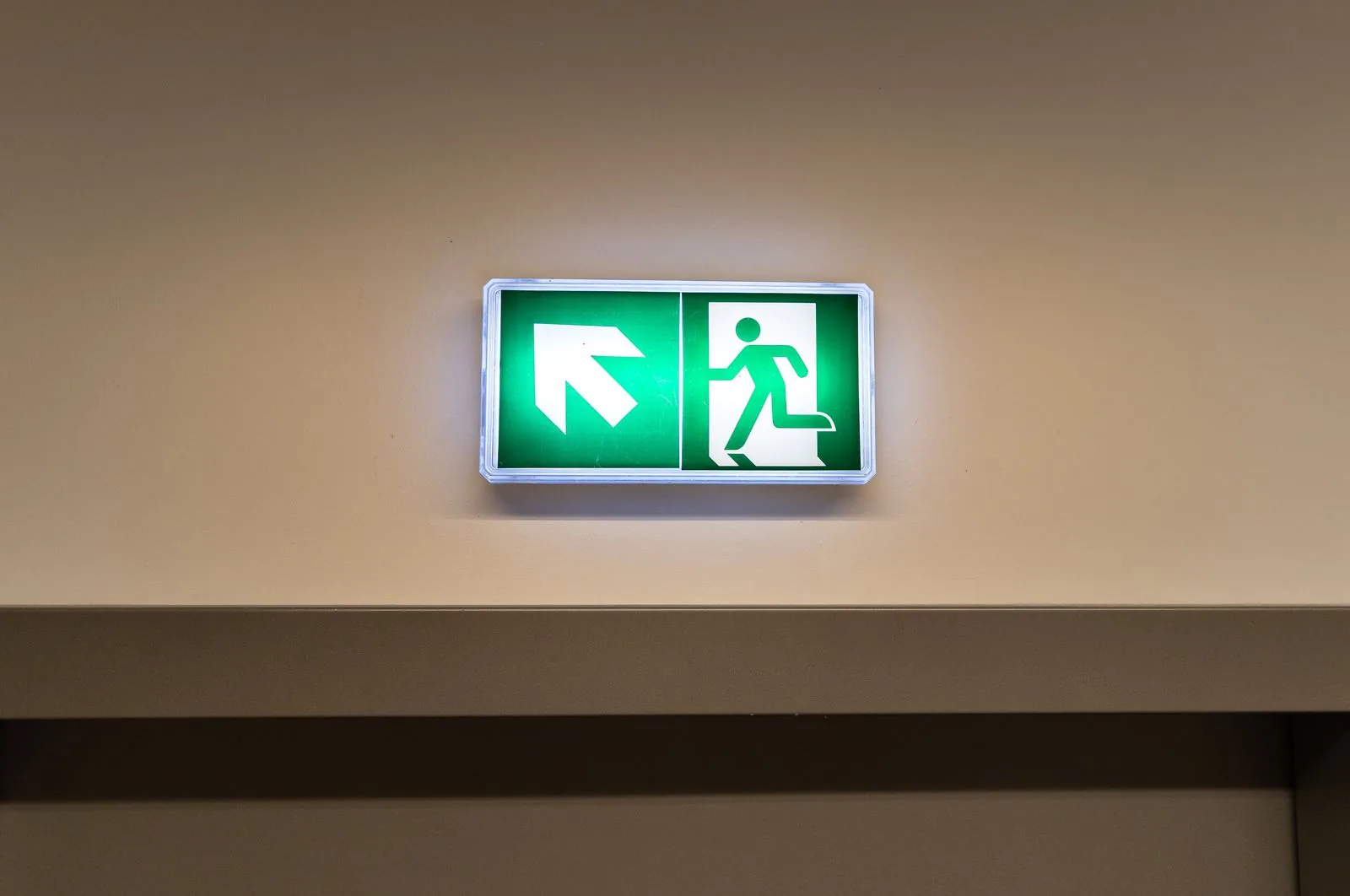
Illuminated green emergency exit sign showing a running figure and arrow
Emergency lighting keeps escape routes visible if the power fails.

You know your building and your residents. We can help you put the right protection in place:

  • Fire alarms: design, installation and servicing to BS 5839-1. See our fire safety and alarm services.
  • Thermal cameras: Hikvision and Dahua thermal cameras as an extra early-warning layer for scooter stores and charging rooms, alongside your fire alarm. We can link the camera to your fire alarm panel as its own zone, so staff know exactly where to go. The Dahua flame detection camera also records CCTV and has two-way audio, which suits e-bike stores where theft is a worry too.
  • Emergency lighting: so escape routes stay lit if the power fails. See emergency lighting.
  • Fire extinguishers: we supply and service extinguishers, including AVD-type lithium-ion battery extinguishers, and advise on the right type for the space. See fire extinguishers.
  • round-the-clock alarm monitoring, and breakdown cover on maintenance contracts, where we aim to get an engineer to you within 4 hours.
  • Safe charging points: as an NICEIC approved contractor we can check existing circuits, including EICRs, and install suitable charging points.
  • Fire risk assessment: we work with a partner fire risk assessor who can review your assessment.

You are welcome to visit our training suite and demo room in Halesowen to see systems working before you decide. SAFE is BAFE and NSI approved, an NICEIC approved contractor, Constructionline Gold and SafeContractor accredited.


Areas we cover

From our Halesowen office we work across the West Midlands and north Worcestershire, including:

  • Halesowen,
  • Dudley,
  • Stourbridge,
  • Sandwell,
  • Birmingham,
  • Hagley,
  • Bromsgrove,
  • Kidderminster,
  • Wolverhampton,
  • Walsall,
  • Solihull,
  • Redditch,
  • the wider Black Country,

Frequently asked questions

Are mobility scooters allowed in communal corridors?

They should not be stored or charged in corridors, stairways or other escape routes. If a scooter caught fire there, smoke could block the way out for everyone.

Do I have to include mobility scooters in my fire risk assessment?

WMFS says Responsible Persons need to make sure the risk from battery-powered transport devices, including mobility scooters, is addressed in the fire risk assessment.

Can residents charge mobility scooters overnight?

WMFS advises against charging overnight, and NFCC guidance suggests restricting charging between 8pm and 8am, when people are likely to be asleep.

Do I need a separate charging room?

Not always, but a dedicated room or outside store is often the safest option. NFCC guidance recommends at least 30 minutes' fire-resisting construction and early warning of fire.

What detection should go in a scooter store?

It depends on the room and how the building is used. A competent fire alarm company should advise, and the store should link to a BS 5839-1 fire alarm.

Will a normal fire extinguisher put out a lithium-ion battery fire?

Battery fires behave differently. Specialist lithium-ion extinguishers exist, but they are only for very small, early-stage fires. Getting out and calling 999 always comes first.

Can a thermal camera replace my fire alarm?

No. Thermal cameras can give an extra early warning of overheating, but they work alongside a BS 5839-1 fire alarm, never as a replacement for one.

Can a thermal camera trigger our fire alarm?

It can be set up to. SAFE can wire a thermal camera's alarm output into an input on the fire alarm panel as its own zone, such as "Battery charging area", designed and commissioned to suit the system. It adds an early warning alongside BS 5839-1 detection, not instead of it.

Who enforces fire safety in the West Midlands?

West Midlands Fire Service across the West Midlands county, and Hereford & Worcester Fire and Rescue Service in Bromsgrove, Kidderminster and Redditch.

Talk to SAFE about mobility scooter safety

If you are reviewing your fire risk assessment, or are not sure your scooter store is right, call SAFE Fire & Security Systems Ltd, Halesowen on 0333 2240247 or contact us online.

Leave a comment

Call usFree site survey