
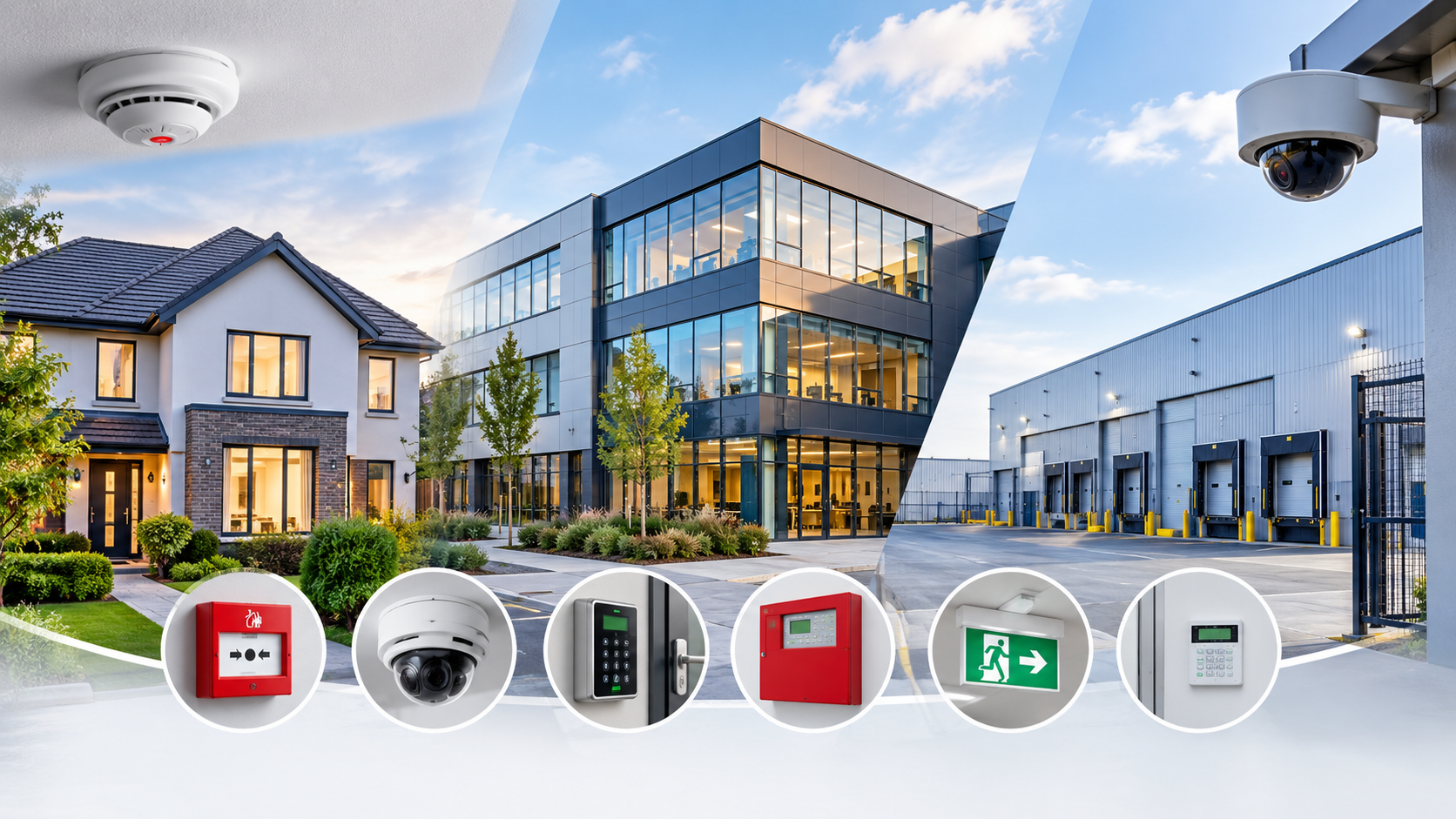
No two properties face the same risks. A three-bedroom house in Halesowen has very different fire and security needs to a warehouse in Wolverhampton, a busy retail unit in Birmingham city centre, or a school in Walsall. Occupancy levels, building layout, the value of what’s inside, opening hours, and the number of people who need to get out safely in an emergency all shape what a suitable fire and security setup actually looks like.
That’s why finding the right fire and security solutions in West Midlands starts with understanding the property itself, not simply installing the same package everywhere. This article looks at how fire and security requirements differ across homes, offices, retail and hospitality venues, warehouses, and specialist premises such as schools and care settings, and what to consider when choosing a provider across Birmingham, Wolverhampton, Dudley, Walsall, Sandwell and the wider region.
Why One Fire & Security Solution Does Not Fit Every Property
It’s tempting to think of fire alarms and security systems as a single product category, but in practice they need to be designed around the building and the people who use it. A domestic smoke alarm system serves a very different purpose to a commercial fire detection panel monitoring dozens of zones across a multi-storey office.
Several factors influence what’s appropriate for a given site:
- Occupancy type – residential, commercial, industrial, or specialist environments such as care homes and schools.
- Building size and layout – open-plan retail floors behave very differently to warehouse racking or multi-room offices.
- Number of people on site – and how quickly they can be evacuated.
- Assets and stock at risk – from personal belongings to expensive equipment or inventory.
- Opening hours and staffing patterns – a 24-hour warehouse has different monitoring needs to a nine-to-five office.
- Regulatory obligations – particularly for commercial and multi-occupancy buildings, where the Regulatory Reform (Fire Safety) Order 2005 places specific duties on the Responsible Person.
A tailored approach means the fire detection, security systems, and monitoring in place actually reflect the risks on site, rather than a generic bundle sold the same way regardless of the building.
Fire & Security Solutions for Homes
For homeowners and landlords across the West Midlands, fire and security needs are usually more straightforward than a commercial building, but they still deserve proper thought rather than an off-the-shelf approach.
Fire and smoke detection. Interlinked smoke alarms and heat detectors, positioned according to the layout of the property, give an early warning if something goes wrong. For rental properties, landlords also have specific legal responsibilities around smoke and carbon monoxide alarms that are worth checking against current guidance for the property type.
Intruder alarms. Modern intruder alarm systems can be app-controlled, giving homeowners the ability to arm, disarm and check the status of their property remotely. This is particularly useful for anyone who travels for work or owns a second property in the region.
CCTV. A well-positioned camera system, whether that’s covering the front of a property, a driveway, or a rear access point, adds a visible deterrent as well as a record if something does happen.
Access considerations. For landlords managing multiple properties, or homeowners with outbuildings and gated access, simple access control measures can reduce the risk of unauthorised entry without adding unnecessary complexity.
The priority for residential properties is usually a system that’s reliable, easy to live with day to day, and proportionate to the property rather than over-specified.
Protecting Offices and Commercial Buildings
Commercial premises bring a different set of considerations. Staff, visitors, contractors and sometimes members of the public all need to be kept safe, and the Responsible Person for the building carries legal obligations to manage fire risk appropriately.
Typical elements of an office or commercial fire and security setup include:
- Fire alarm systems designed around the building layout and installed in line with British Standards such as BS 5839.
- Emergency lighting to keep escape routes visible if the power fails or an evacuation is needed.
- CCTV systems covering entrances, communal areas and vulnerable points.
- Intruder alarms to protect the building outside working hours.
- Access control, whether that’s keycards, fobs, PIN codes or biometric readers, to manage who can enter which areas.
- Monitoring, so that alarm activations are picked up promptly rather than relying on someone being on site to notice.
For most commercial buildings, these systems work best when they’re integrated, so a triggered intruder alarm or fire event is picked up and responded to consistently, rather than each system operating in isolation.
Fire & Security for Retail, Hospitality and Public-Facing Businesses
Retail units, restaurants, pubs, hotels and other public-facing businesses carry risks that don’t apply in the same way to a typical office. Customers are moving through the space, stock or valuables may be on open display, and commercial kitchens introduce a specific fire risk that needs to be planned for.
Key considerations for this sector include:
- Fire detection suited to kitchen environments, where heat and steam can trigger false alarms if the wrong detector type is used.
- CCTV covering till points, stock rooms and entrances, both as a deterrent and to support any investigation if needed.
- Intruder alarms for out-of-hours protection, particularly where high-value stock is held.
- Clear, well-maintained emergency lighting and signage so customers and staff can evacuate safely during busy trading hours.
- Access control for stock rooms, offices or areas not meant for public access.
Because these businesses are often open to the public for long hours, with high footfall and a mix of staff experience levels, systems need to be dependable and straightforward for staff to understand, not just technically sound.
Security and Fire Protection for Warehouses and Industrial Premises
Larger industrial and warehouse sites across the West Midlands typically need more extensive coverage than a smaller commercial building, simply because of the scale involved.
Considerations for warehouses and industrial premises include:
- Advanced fire detection across large open floor areas and high racking, where fire can spread quickly if not caught early.
- CCTV covering loading bays, perimeters and internal areas, often across multiple buildings on one site.
- Access control managing staff, contractor and visitor movement across a larger footprint.
- Intruder detection for out-of-hours protection of stock, machinery and vehicles.
- Perimeter security, including gates, fencing and external detection where the site boundary itself needs protecting.
- Emergency lighting across warehouse floors and escape routes, which can be substantial distances in larger buildings.
- Monitoring, so that any activation, whether fire or intrusion, is acted on quickly regardless of the time of day.
Industrial sites also often have specific risks tied to what’s stored or manufactured on site, which is why a proper site survey matters more here than almost anywhere else. What works for a distribution warehouse won’t necessarily suit a manufacturing unit with different materials, processes and hazards.
Schools, Healthcare and Other Specialist Premises
Schools, nurseries, care homes and healthcare settings need fire and security planning that reflects the people who use the building. Evacuation isn’t always straightforward when it involves children, elderly residents, or people with reduced mobility, and that has a direct bearing on system design.
In care environments, for example, a nurse call system allows staff to respond quickly to residents who need assistance, working alongside fire detection rather than replacing it. In schools, fire alarm systems need to account for high occupancy at specific times of day, alongside secure access control to manage who can enter the building during the school day.
These settings often also have external oversight, such as Ofsted inspections for education and childcare providers, or CQC requirements in healthcare, which can add time pressure to getting systems installed, upgraded or serviced correctly. Getting the right specification from the outset, based on occupancy and vulnerability rather than building size alone, matters more in these environments than almost anywhere else.
Why Local Knowledge Matters in the West Midlands
Working with a fire and security provider that understands the region has practical benefits. Property types across Birmingham, Wolverhampton, Dudley, Walsall, Sandwell, Halesowen, West Bromwich and Stourbridge vary considerably, from Victorian terraces and converted commercial units through to modern warehouse developments and industrial estates built for manufacturing.
A provider based in the region, rather than operating remotely, is also better placed to respond quickly when something needs attention, whether that’s a routine service visit or an urgent call-out. Local knowledge of building types, common site layouts and the kinds of businesses operating across the area all help when it comes to designing a system that actually fits, rather than applying a standard specification regardless of location.
Choosing the Right Fire & Security Partner
Whatever type of property is involved, a few practical points are worth checking before choosing
a provider:
- Experience across relevant property types – residential, commercial and industrial work each require different expertise
- Relevant accreditations – look for recognised industry certifications, which indicate a provider works to established standards
- Proper system design, based on a genuine site survey rather than a generic quote
- Installation quality, carried out by qualified engineers
- Ongoing maintenance, since fire and security systems need regular servicing to stay compliant and reliable
- Monitoring arrangements, where relevant, so activations are dealt with promptly
- Compliance support, including certification that demonstrates the work meets applicable British Standards
- Ongoing support, for when questions or issues come up after installation
It’s worth noting that specific legal responsibilities depend on the type of premises, its use, and
the circumstances involved, so this article is general guidance rather than a substitute for a
proper site assessment or professional fire risk advice where that’s needed.
Protecting What Matters with a Tailored Approach
Homes, offices, retail units, warehouses and specialist premises like schools and care homes all carry different risks, different occupancy patterns, and different regulatory obligations. A fire and security setup that works well in one context can be entirely wrong for another, which is why a tailored approach, starting with a proper understanding of the building and the people in it, matters more than simply choosing the most popular package
Get in Touch
If you’re weighing up what fire and security solutions are right for your home, business or site across the West Midlands, a proper site survey is the best starting point. Get in touch with Safe Fire & Security to discuss your property and what a tailored setup could look like, or call free on 0333 2240247.
Frequently Asked Questions
What's the difference between residential and commercial fire alarm systems?
Residential systems are typically interlinked smoke and heat alarms designed for a small number of rooms. Commercial systems are usually zoned, connected to a control panel, and designed in line with standards such as BS 5839 to cover larger buildings with multiple occupants and evacuation routes.
Do I need a fire risk assessment for my business premises?
Most non-domestic premises in England and Wales fall under the Regulatory Reform (Fire Safety) Order 2005, which places a duty on the Responsible Person to carry out and maintain a fire risk assessment. Specific requirements depend on the premises, so it’s worth checking against current guidance or seeking professional advice for your situation.
Can CCTV and intruder alarms be integrated with fire detection?
Yes, in many commercial and industrial settings these systems can be integrated so that alarms, whether fire or intrusion related, are picked up and responded to consistently rather than monitored separately.
How often should fire alarms and emergency lighting be tested?
This depends on the system and the standard it’s installed to, but commercial fire alarms and emergency lighting typically need routine checks (often monthly) alongside a more thorough annual service to remain compliant and reliable.
What areas of the West Midlands do you cover?
Fire and security work is carried out across Birmingham, Wolverhampton, Dudley, Walsall, Sandwell, Halesowen, West Bromwich, Stourbridge and the surrounding West Midlands area.
Is access control suitable for smaller businesses, or only larger sites?
Access control can be scaled to suit the property, from a single door fob system for a small office through to multi-door, multi-user setups for larger commercial or industrial sites.
Leave a comment