Let’s be honest, no business owner wants to think about break-ins. But they happen. And when they do, the damage goes beyond what’s stolen. Operations get disrupted, clients lose confidence, and your team feels unsafe.
A good intruder alarm isn’t a luxury anymore. For most UK businesses, it’s just part of keeping the lights on.
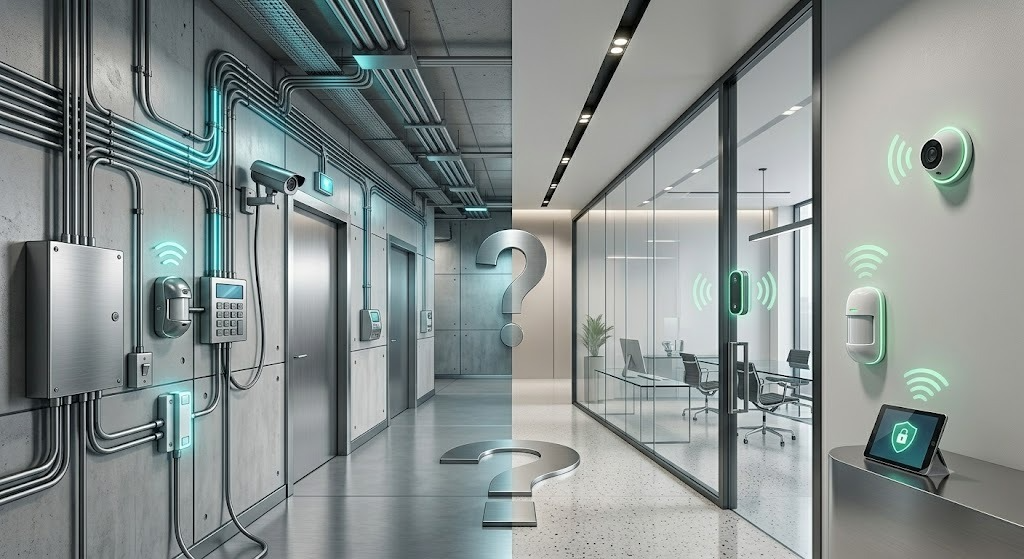
But here’s where people get stuck: wired or wireless? It sounds like a small technical choice, but it actually affects how the system gets installed, how much it costs long-term, how reliable it is, and whether it’ll still work for you five years down the line.
This guide cuts through the jargon so you can make the right call or at least walk into a conversation with a security company knowing what to ask.
So, What’s a Wired Alarm System?
Simple idea: everything is physically connected. Your sensors, detectors, keypads, and sirens all run back to a central control panel through cables built into the walls and floors of your building.
Those cables carry both power and signals — so the system is self-contained and doesn’t rely on batteries or wireless signals to function.
Key Components
- Central control panel (the brain of the system)
- Passive infrared (PIR) motion detectors
- Door and window contact sensors
- Internal and external sounders or sirens
- Keypads for arming and disarming
- Battery back-up to maintain operation during power cuts
Where Wired Systems Work Best
Wired alarm systems are particularly well-suited to large, purpose-built or owned commercial premises where cable installation is practical during construction or a major refurbishment.
Common use cases include:
- Warehouses and distribution centres
- Industrial units and manufacturing facilities
- Large office buildings and multi-floor premises
- Schools, colleges, and healthcare facilities
- Retail units with dedicated security infrastructure
What Is a Wireless Intruder Alarm System?
A wireless intruder alarm system communicates between devices using radio frequency (RF) signals rather than physical cables. Each sensor and detector runs on its own battery or low-power connection, transmitting data back to the control panel wirelessly.
Modern wireless security systems use encrypted, two-way communication to ensure signals cannot be easily jammed or intercepted — addressing the key reliability concerns that once made wireless systems a secondary choice.
Key Components
- Wireless control panel or hub
- Battery-powered PIR motion detectors
- Wireless door and window contacts
- RF-connected keypads and fobs
- Wireless internal/external sounders
- Remote monitoring via app or dedicated monitoring station
Where Wireless Systems Work Best
Wireless intruder alarm systems are an excellent choice for:
- Small offices, retail units, and commercial spaces where cabling is impractical
- Rented or leased properties where building alterations are restricted
- Listed buildings or historic premises where drilling or chasing is not permitted
- Businesses that require a fast installation with minimal disruption
- Retrofit upgrades to existing premises
Which System Is Best for Your Business?
Honestly, there’s no one-size-fits-all answer. It comes down to your premises, how you use the space, and what your insurer requires.
Own a large commercial property or planning a major refurb? Go wired. In a rented office or need something up and running quickly? Wireless will serve you better.
And if your premises are complex or likely to change, a hybrid system — wired in fixed areas, wireless where flexibility matters — often hits the sweet spot. A good security company will tell you which combination makes sense for your site.
Wired vs Wireless Alarm Systems: Key Differences
Here is how the two system types compare across the factors that matter most to businesses:
| Factor | Wired | Wireless |
|---|---|---|
| Installation |
Cables run through walls & floors. Disruptive — best for new builds or refurbs. Slow & invasive |
No cables, no drilling. Usually done in hours with zero disruption. Fast & clean |
| Reliability |
No signal interference. Solid choice for industrial sites with heavy machinery. RF-proof |
Encrypted, frequency-hopping signals. Comparable to wired in most environments. Modern & secure |
| Maintenance |
Mains-powered — no battery swaps needed. Still requires regular engineer servicing. Low upkeep |
Sensors need periodic battery changes, but smart alerts flag low batteries early. Battery changes |
| Scalability |
Expanding means new cable runs — more time and cost involved. Less flexible |
Just pair a new device. Easy to grow as your business does. Very flexible |
| Cost |
Lower hardware cost, but higher install labour. Long-term costs are comparable. Higher install |
Slightly higher hardware cost, lower install cost. Budget for battery upkeep. Higher hardware |
| Security level | Both can achieve the same Grade classification — what matters is correct specification and certified installation, not the cable type. | |
Pros and Cons of Each System
Industry Standards & Compliance in the UK
Compliance isn’t just paperwork — it affects your insurance cover and whether you can get a police response.
UK alarm systems are graded from Grade 1 (low-risk) to Grade 4 (high-risk commercial). Your insurer will specify which grade you need. Both wired and wireless systems can meet any grade, as long as they’re properly designed and installed by a certified company.
One thing worth knowing: many insurers won’t pay out on theft claims unless your alarm was fitted by an accredited installer. And if you want police response, your system will need to meet ACPO standards through an NSI Gold or NACOSS-certified provider.
Why Professional Installation Matters
DIY alarm kits have come a long way — but for a business, the risks aren’t worth it:
- Insurance — Most commercial insurers won't honour a claim if the system wasn't installed by an accredited contractor.
- Grade certification— Getting the right grade means proper commissioning and documentation. That needs a qualified engineer, not a self-install guide.
- Site assessment— A professional will spot blind spots and high-risk entry points a generic kit never accounts for.
- Ongoing servicing — Faults get caught before they become problems, keeping you covered and compliant.
- Monitoring — A professional installer connects your system to a 24/7 Alarm Receiving Centre, so someone's always watching.
Wired systems
Advantages
- No RF interference or signal disruption
- No battery replacements needed
- Lower long-term maintenance
- Preferred for high-grade, high-security sites
- Proven technology with a long commercial track record
Disadvantages
- Disruptive, time-consuming installation
- Not suited to rented, leased or listed buildings
- Inflexible if premises layout changes
- Higher install costs due to labour-intensive cabling
Wireless systems
Advantages
- Fast, non-invasive installation
- Ideal for rented or restricted properties
- Easy to expand, move or reconfigure
- Encrypted — strong protection against signal jamming
- Remote monitoring via smartphone or web portal
Disadvantages
- Ongoing battery replacements across devices
- Less suited to high RF interference environments
- Slightly higher upfront hardware costs
Conclusion
At the end of the day, the wired vs wireless debate is almost secondary. What really matters is getting the right system for your specific building designed properly, installed correctly, and maintained over time.
The smartest move? Talk to a qualified security company before making any decisions. They’ll assess your site, match a system to your risk level, and make sure you’re covered both by the alarm and by your insurer.
Ready to find the right fit? Get in touch with our team for a free, no-obligation consultation. We work with businesses across the UK to deliver commercial security that actually does its job.
Frequently Asked Questions
Are wireless intruder alarm systems as reliable as wired systems?
Yes — modern wireless intruder alarm systems use encrypted, frequency-hopping communication that is highly resistant to interference and jamming. Whilst older wireless systems had notable limitations, today’s commercial-grade wireless systems are considered comparable in reliability to wired alternatives for the vast majority of business premises.
Will my insurance be valid with a wireless alarm system?
Provided the wireless alarm system has been installed by an NSI or SSAIB accredited installer to the appropriate grade for your premises, most commercial insurers will accept it. Always confirm your insurer’s specific requirements before committing to a system, and ensure you receive the correct certification documentation from your installer.
How long does it take to install a wireless intruder alarm system?
For most small to medium-sized commercial premises, a wireless intruder alarm system can typically be installed within one to two days. Larger or more complex installations may take longer. One of the key advantages of wireless systems is that installation is significantly faster and less disruptive than wired equivalents.
Can I add more sensors to my alarm system in the future?
Yes — both wired and wireless systems can be expanded, though wireless systems are generally easier to scale. Adding a sensor to a wireless system requires pairing a new device with the control panel, whereas expanding a wired system may require additional cable runs. Discuss future scalability requirements with your installer before committing to a system.
What is the difference between a monitored and unmonitored intruder alarm?
A monitored intruder alarm is connected to a 24/7 Alarm Receiving Centre (ARC). When the alarm is triggered, the ARC contacts keyholders and, where appropriate, emergency services. An unmonitored system will sound an audible alarm locally but relies on bystanders or neighbouring properties noticing the activation. For commercial premises, monitored systems are strongly recommended and are typically required for police response or enhanced insurance terms.
- Intruder Alarm Systems
- Wired Alarm Systems
- Wireless Alarm Systems
- Business Security Systems
- Commercial Security Solutions
- Burglar Alarm Installation
- Commercial Property Protection